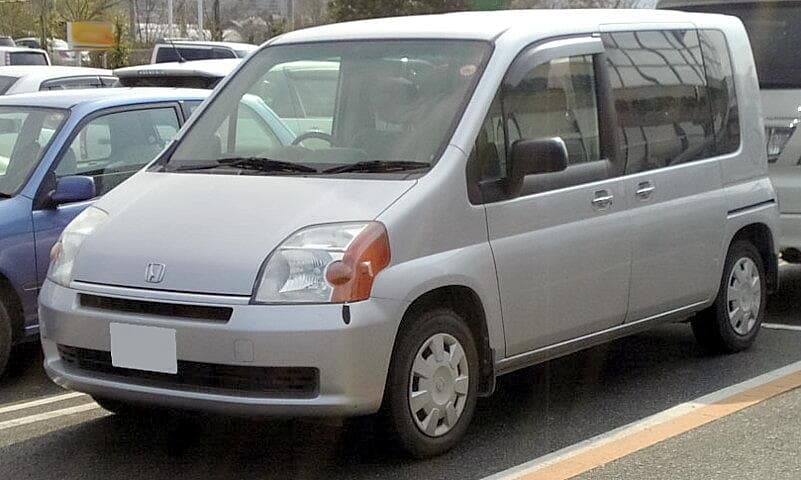
 2002–2008GB1GB11.5 petrolPetrolSee faults & what to checkPhoto: Kuha455405 via Wikimedia Commons, CC BY-SA 3.0.
Honda2001–2008 Major issues documented
Honda Mobilio: common faults & what to check
Thinking about buying a used Honda Mobilio (2001–2008) in New Zealand? We've documented 11 known faults for this model spanning transmission, body & rust, electrical, and engine. Each researched and verified before it's published. The most serious issues here are rated major. Every one is listed below with its symptoms and repair cost, and each has its own page with where to look and what to ask the seller. Free, no account needed.
Check this exact Honda Mobilio
- Odometer history
- Money owing
- Reported stolen
- Ownership history
11
Major
$350–$1,050
9
Which Honda Mobilio are you looking at?
Petrol
2002–2008GB1GB11.5 petrolPetrolSee faults & what to checkPhoto: Kuha455405 via Wikimedia Commons, CC BY-SA 3.0.Now narrow it to the engine
Start your free check on this Honda Mobilio
Honda Mobilio
Likely — same engine family
Honda Mobilio
Narrowed by capacity and fuel. No engine code is recorded for this option, so a fault specific to one engine of that size cannot be confirmed from it.
Matched on capacity and fuel, not on an engine code.
- 2 documented faults name an engine this selection cannot confirm. They are listed separately below.
matched on 1.5L engine
What to look out for
Costly issue
On any GB1 Mobilio over 150,000 km treat tensioner replacement as a maintenance item.
L15A timing chain tensioner bleed-down rattle
The Honda Mobilio GB1 shares the same L15A 1.5L i-VTEC engine as the first-generation Freed and suffers an identical timing chain tensioner check-valve degradation fault. In imported examples now 16–24 years old, the tensioner check valve O-ring has often hardened and shrunk, allowing rapid oil drain-back after shutdown. Cold-start rattle is near-universal on high-mileage Mobilio GB1 units unless the tensioner has been proactively replaced. At this vehicle age, the plastic timing chain guide rails are also subject to brittleness from heat cycling and should be inspected simultaneously. Chain stretch from tensioner slack compounds wear on the VTC actuator sprocket.
What you would notice
Costly issue
Test drive and feel for rhythmic vibration during light acceleration.
CVT Shudder on Acceleration
The Mobilio CVT develops shudder during light acceleration as the belt and pulley surface wear. Honda-specific CVT fluid must be used.
What you would notice
Costly issue
Inspect boot for splitting.
Front Lower Arm Ball Joint Wear
Front lower arm ball joints wear causing clunking and handling imprecision.
What you would notice
Costly issue
Check for pulling under braking.
Brake Caliper Guide Pin Seizure
Front brake caliper guide pins seize from corrosion causing uneven pad wear and brake pull.
What you would notice
Costly issue
Pull the ATF dipstick with the engine warm and the transmission cycled through all gears — fluid should be translucent red, not brown or dark.
Automatic transmission harsh shifts from fluid degradation
The Honda Mobilio GB1's 4-speed automatic transmission relies on ATF that maintains precise viscosity and friction-modifier chemistry to control clutch pack engagement smoothness. In imported units now 16–24 years old, the ATF is often original or has been serviced infrequently, resulting in oxidised, darkened fluid with depleted additives. Degraded fluid causes the shift solenoids to operate inconsistently, and the clutch packs engage abruptly rather than progressively. The result is harsh, jerky upshifts — particularly the 1-2 and 2-3 shift under light throttle at low speed. A full drain-and-fill with Honda Genuine ATF-Z1 or DW-1 can restore smoothness in early-stage cases, but heavily worn clutch packs will remain rough regardless of fluid condition. Multiple partial fluid exchanges are required to adequately dilute aged fluid.
What you would notice
Costly issue
Inspect the front subframe and mounts for structural rust, probe sills and door bottoms, and check underbody condition.
Subframe and lower body rust on NZ imports
Mobilio imports rust in the front subframe, lower sills and door bottoms as drains block and moisture sits, a structural WOF concern on older coastal-NZ examples that can be costly to repair.
What you would notice
Honda Mobilio service schedule
Second Generation (DD4/DD5) · 2014–2026 · 1.5L (L15Z1) - i-VTEC efficiency engine
Due by distance
- 100,000 km
Spark plug replacement and initial belt inspections become a priority for the L15Z1 engine here.
- 150,000 km
Deep-dive check on suspension bushings and the CVT transmission fluid condition.
- 200,000 km
Comprehensive cooling system health check, including the radiator and hoses, for long-term engine longevity.
Second Generation (DD4/DD5) · 2014–2026 · 1.5L (i-DTEC) - Turbo diesel efficiency version
Due by distance
- 100,000 km
Verify the coolant and brake fluid have been refreshed - often overlooked at this point.
- 150,000 km
Have the turbocharger inspected and ensure the DPF (Diesel Particulate Filter) is functioning efficiently.
- 200,000 km
Review suspension components - bushings and shock absorbers may show natural fatigue.
First Generation (GB1/GB2) · 2001–2008 · 1.5L (L15A) - Base i-DSI/VTEC engine
Due by distance
- 100,000 km
Ensure the spark plugs - especially on the i-DSI engine with eight plugs - have been replaced.
- 150,000 km
Have the suspension bushings and engine mounts inspected for wear.
- 200,000 km
Focus on the radiator and cooling hoses to keep the engine running at optimal temperatures.
See all 11 documented issues
Engine, transmission & cooling
01L15A timing chain tensioner bleed-down rattle
02L15A timing chain wear
OccasionalEngine $500–$1,500 to fix
The Mobilio's 1.5 L15A uses a timing chain that can rattle at start-up with age and long oil intervals, and neglected tensioner/guides eventually risk timing. Common on higher-km import examples.
 Example of the part — not this vehicle
The front of a twin-cam engine with the timing cover off — chain, sprockets and guides.
Symptoms to notice
What to check
Ask the seller
Electrical
03Electric Power Steering Failure
OccasionalElectrical $600–$2,000 to fix
EPS column motor or sensor fails causing loss of power assistance.
Symptoms to notice
What to check
Ask the seller
04Power Sliding Door Cable Fraying
CommonElectrical $350–$1,400 to fix
The Mobilio power sliding door cables fray at the guide pulleys causing slow or stuck door operation.
Symptoms to notice
What to check
Ask the seller
05Sliding door cable and roller wear
CommonElectrical $200–$1,000 to fix
The Mobilio's sliding doors wear at the cables, rollers and tracks, causing sticking, misalignment and doors that jump the track or won't latch. A common wear point on this compact people-mover.
Symptoms to notice
What to check
Ask the seller
Body, brakes, suspension & interior
06Subframe and lower body rust on NZ imports
OccasionalBody & Rust $400–$2,500 to fix
Mobilio imports rust in the front subframe, lower sills and door bottoms as drains block and moisture sits, a structural WOF concern on older coastal-NZ examples that can be costly to repair.
Symptoms to notice
What to check
Ask the seller
07Front Lower Arm Ball Joint Wear
CommonSuspension $300–$700 to fix
Front lower arm ball joints wear causing clunking and handling imprecision.
 Example of the part — not this vehicle
A separated lower ball joint: the control arm has dropped and the wheel has splayed out under the guard.
Symptoms to notice
What to check
Ask the seller
08Brake Caliper Guide Pin Seizure
CommonBrakes $150–$500 to fix
Front brake caliper guide pins seize from corrosion causing uneven pad wear and brake pull.
Symptoms to notice
What to check
Ask the seller
09Rear Suspension Beam Bush Collapse
CommonSuspension $200–$550 to fix
Rear beam axle bushes harden and collapse causing knocking and imprecise handling.
Symptoms to notice
What to check
Ask the seller
Depends on which engine this Honda Mobilio has — 2
Engine, transmission & cooling
01CVT Shudder on Acceleration
Can't confirm for this car
Very commonTransmission $500–$3,000 to fix
Can't confirm for this car
The Mobilio CVT develops shudder during light acceleration as the belt and pulley surface wear. Honda-specific CVT fluid must be used.
Symptoms to notice
What to check
Ask the seller
02Automatic transmission harsh shifts from fluid degradation
Can't confirm for this carHonda Mobilio faults in detail
What these repairs cost on other cars
Some of the Honda Mobilio’s documented faults are repairs other models share. Each page lists the documented NZ cost for every model it affects.
Other Honda models
Honda Mobilio buyer questions
Is the Honda Mobilio reliable?
Like any used car, it depends on the specific example and its service history. Across the 11 documented faults for the Honda Mobilio, the recurring problem areas are transmission, body & rust, and electrical. A Honda Mobilio with a full service history and no signs of the issues listed on this page can be a sound buy but each one needs to be checked individually before you commit.
What are the most common problems with a used Honda Mobilio?
We've catalogued 11 known faults for the Honda Mobilio, covering transmission, body & rust, and electrical. All 11 are written out in full on this page, with the symptoms to notice, what to inspect, and typical repair costs for each. Free to read, no account needed.
How much do repairs cost on a Honda Mobilio?
Most single repairs on the Honda Mobilio fall between $350–$1,050 at NZ independent-workshop rates. Some of the 11 documented faults cost less and a few cost considerably more, and no one car needs them all. Knowing which ones to look for before you view is what lets you negotiate the price down or walk away.
Should I get a pre-purchase inspection on a Honda Mobilio?
Yes. A Honda Mobilio inspection focused on its known weak points is the single best way to avoid an expensive mistake. KickTyres gives you a guided, model-specific inspection plus a market valuation and negotiation figure for $24.90 far less than the cost of missing one of the faults on this page.