How to check a cambelt before you buy
A cambelt that lets go can destroy the engine on a lot of cars. It is also one of the few big-ticket items you can investigate yourself in ten minutes, before you have spent anything.
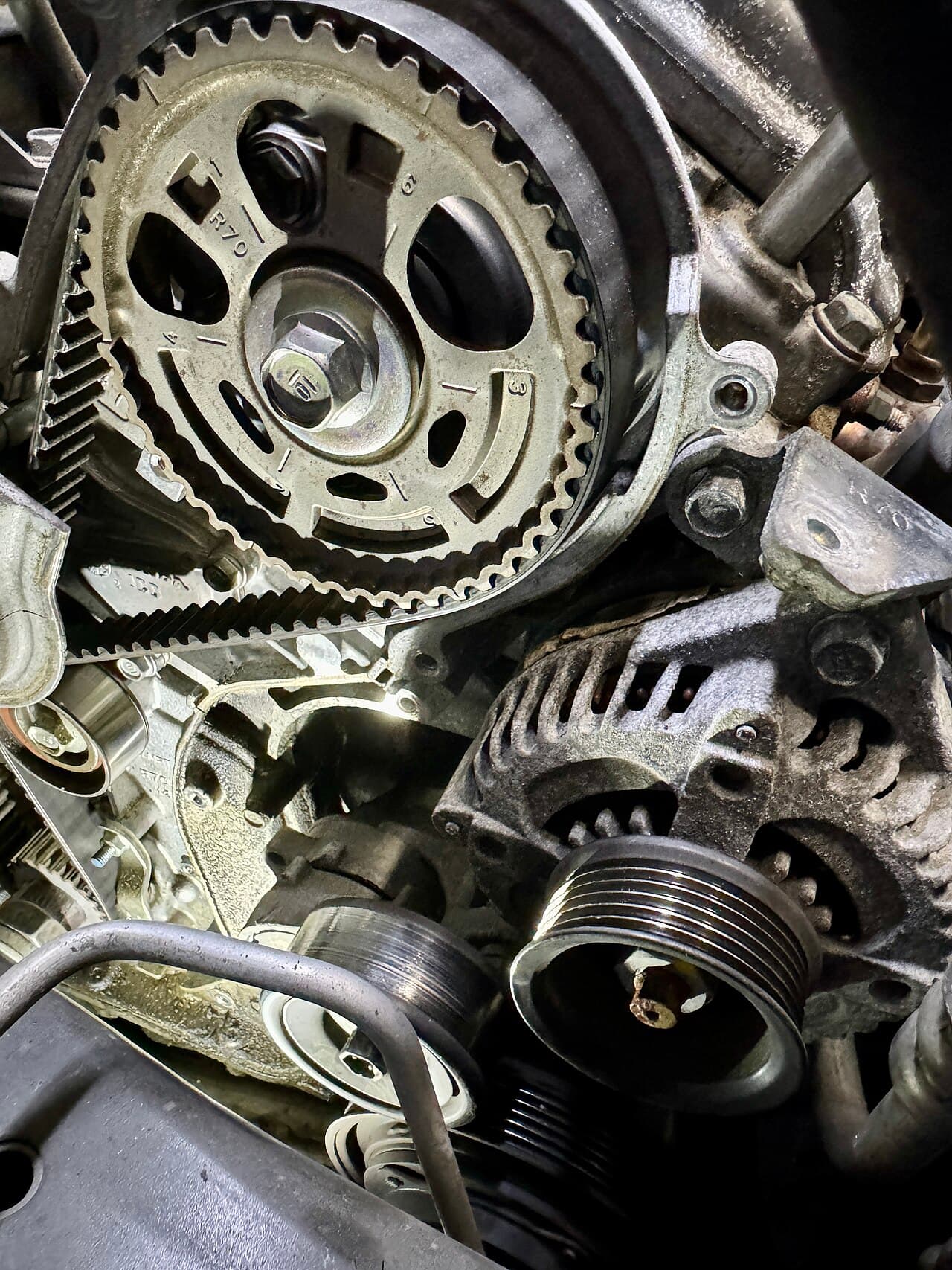
A cambelt keeps the top of the engine turning in step with the bottom. On a great many engines, if it snaps, the valves and the pistons try to occupy the same space and the engine is finished. That is not a scare story, it is why the belt has a replacement interval printed in the manual.
It is also, unusually, a big-ticket risk you can investigate yourself before you spend a cent. Here is the order to do it in.
1. First, find out whether the car even has one
Plenty of engines use a timing CHAIN instead, which is designed to last the life of the engine and has no service interval at all. Asking "when was the cambelt done?" on a chain-driven engine tells a seller you do not know the car, and worse, it means you spend your one big question on something that does not apply.
This is engine-specific, not model-specific. The same nameplate across two generations can be belt in one and chain in the other, and two engines of the same capacity in the same car can differ. Check the documented servicing for that exact model and engine rather than assuming.
2. Ask for the receipt, not the answer
"Yeah, it's been done" is worth nothing. A cambelt job leaves paperwork: an invoice with the date, the odometer reading at the time, and. This matters, whether the water pump and tensioner were replaced with it.
A belt changed without the water pump on an engine where the pump is driven by that belt is a job half done. When the pump fails, it takes the new belt with it, and you pay the whole labour bill again.
3. Do the arithmetic yourself
- 1.Find the interval for that engine, most fall between 90,000 and 150,000 km, and many also carry a TIME limit of around 5 to 10 years.
- 2.Take the odometer reading on the receipt, add the interval. That is when it is next due.
- 3.Take the date on the receipt, add the time limit. That is also when it is next due.
- 4.Whichever comes first is the real answer. A low-mileage car that sat in a garage for eight years is due on time, not on distance, rubber perishes whether the car moves or not.
4. Look at it, if you can see it
On some engines a corner of the belt is visible through an inspection window or behind a small cover. If you can see it, you are looking for glazing (a shiny, hard surface instead of a matte one), fine cracks across the teeth, and any fraying at the edges. Any of those means it is going, regardless of what the paperwork says.
Do not remove covers on someone else's car, and do not put your hands anywhere near it with the engine running.
5. Price it in before you negotiate
If the belt is due, or you cannot prove it is not, that is a real number on the purchase, typically several hundred to well over a thousand dollars once the pump and tensioner are included, and more on engines where access is awkward. It is a fair thing to say out loud: the car needs a belt, here is the quote, here is my offer.
What you should not do is buy it hoping. An overdue belt is one of the few faults where the failure mode is the whole engine.
Find out what your car actually has
Belt or chain, the interval, and every other fault documented for that model and engine. Free.
Check the model before you view
Every documented fault for these models, with the years and engines each one applies to.
Frequently asked questions
How do I know if my car has a cambelt or a timing chain?
It depends on the engine, not the badge or even the model: the same nameplate can be belt-driven in one generation and chain-driven in the next, and two engines of the same capacity in the same car can differ. Look it up against the specific engine code, or check the servicing documented for that model and engine rather than assuming from the model name.
What happens if a cambelt breaks?
On an interference engine, which is most of them: the valves and pistons collide and the engine is normally beyond economic repair. On a non-interference engine it stops and you get it towed. Because you cannot tell which you have by looking, an overdue belt is treated as an engine-destroying risk.
Does a cambelt expire on time as well as on kilometres?
Yes, and this is what catches out low-mileage cars. Most manufacturers publish both a distance interval and a time limit, commonly somewhere between five and ten years, because the rubber perishes whether the car is driven or parked. Whichever limit arrives first is the one that counts.
Should the water pump be replaced with the cambelt?
On engines where the pump is driven by the timing belt, yes, almost always. The labour to reach the pump is the same labour already being paid for, and if the pump fails later it destroys the new belt and you pay that bill twice. A cambelt invoice that does not mention the pump is worth asking about.
Keep reading