 2000–2005CPCPEngine not documented for this generationEngine not documentedSee faults & what to checkPhoto: TTTNIS via Wikimedia Commons, Public domain.
Mazda1999–2018 Critical issues documented
Mazda Mazda5: common faults & what to check
Thinking about buying a used Mazda Mazda5 (1999–2018) in New Zealand? We've documented 12 known faults for this model spanning engine, suspension, transmission, and electrical. Each researched and verified before it's published. The most serious issues here are rated critical. Every one is listed below with its symptoms and repair cost, and each has its own page with where to look and what to ask the seller. Free, no account needed.
Check this exact Mazda Mazda5
- Odometer history
- Money owing
- Reported stolen
- Ownership history
12
Critical
$400–$900
7
Which Mazda Mazda5 are you looking at?
Engine not documented
2000–2005CPCPEngine not documented for this generationEngine not documentedSee faults & what to checkPhoto: TTTNIS via Wikimedia Commons, Public domain.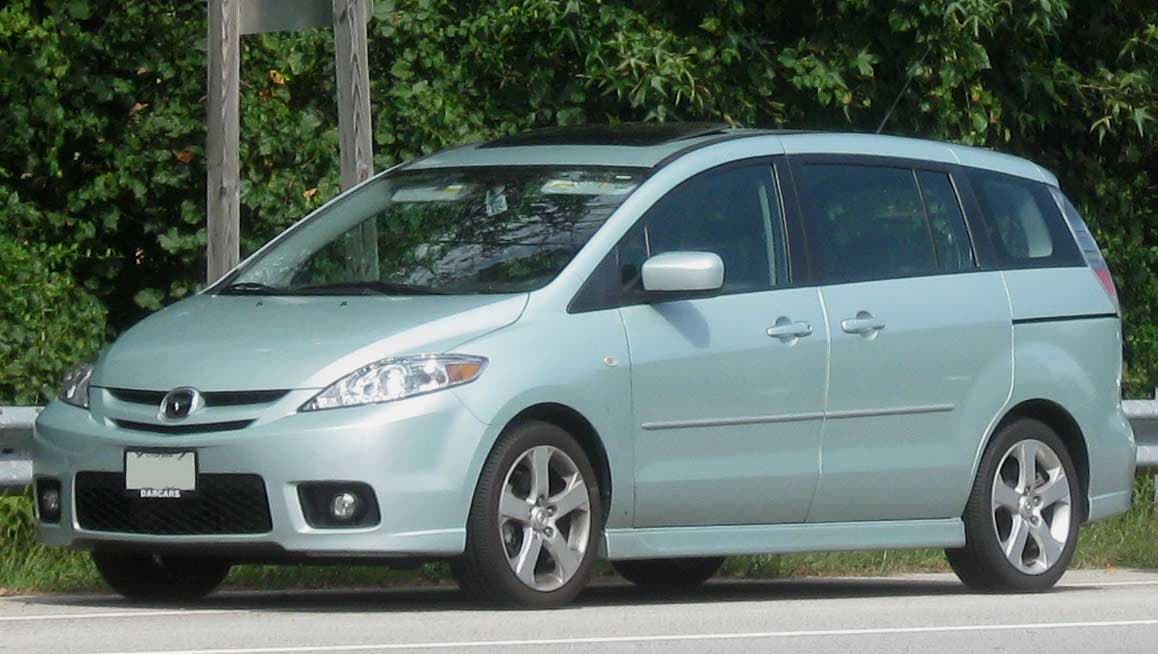 2005–2010CRCREngine not documented for this generationEngine not documentedSee faults & what to checkPhoto: IFCAR via Wikimedia Commons, Public domain.
 2010–2018CWCWEngine not documented for this generationEngine not documentedSee faults & what to checkKickTyres illustration, not a photograph.
Now narrow it to the engine
Start your free check on this Mazda Mazda5
Mazda Mazda5Engine not picked yet
Pick the engine above first: the Mazda5 came with 2, and without it the report has to show all of their faults. Pick the engine
Can't confirm for this car
Mazda Mazda5
Nothing has been narrowed yet, so nothing below is a claim about a particular car. Pick a year and an engine to see which faults apply.
Tell us the engine, or check the engine code on the car, before relying on this.
matched on no vehicle context
What to look out for
Serious issue
Obtain timing belt records and confirm interval compliance: typically 100,000 km or 10 years for FS-ZE and LF-VE.
Timing belt failure — interference engine (FS-ZE / LF-VE)
The CP Premacy uses the FS-ZE 1.8 and the CW Premacy uses the LF-VE 2.0, both interference-design engines. Belt snap causes immediate valve-to-piston contact and engine write-off. NZ examples are predominantly JDM imports and arrive with Japanese service records that may not indicate interval clearly for local buyers. The belt is concealed behind covers, making visual inspection without partial disassembly impractical.
What you would notice
Serious issue
Start the engine from cold and listen for a rattling or slapping noise from the front of the engine that should settle within 3–5 seconds.
LF-VD Timing Chain Guide and Tensioner Wear
The LF-VD 2.0-litre engine uses a simplex timing chain with plastic guide rails and a hydraulic tensioner. At high mileage, typically above 150,000 km, the plastic guide material wears and cracks, and the tensioner piston loses sealing pressure — particularly if oil change intervals have been extended. The result is chain slap noise on cold start that can progress to chain skip and valve-to-piston contact if neglected. NZ-imported units frequently arrive with undisclosed mileage or unknown service histories, increasing the incidence.
What you would notice
Costly issue
For hydraulic systems: inspect the steering rack boots for power steering fluid contamination and the reservoir for low fluid level.
Electric Power Steering Rack Seal and Fluid Leak
Premacy CR models fitted with hydraulic-assist power steering develop weeping and then active leaks at the inner rack seals and the high-pressure hose banjo fittings. The rack pinion seal fails due to age hardening of the rubber compounds, and the power steering fluid contaminates the subframe and surrounding chassis. CW models with electric power steering (EPS) develop a different failure: the motor control unit overheats or develops solder joint failures, triggering a loss-of-assist condition. Both variants generate a dashboard EPS or PS warning lamp.
What you would notice
Costly issue
Test drive at 80-100 km/h with very light throttle and feel for rhythmic vibration.
Automatic Transmission Torque Converter Shudder
4-speed automatic torque converter develops lock-up clutch shudder under light throttle at highway cruise.
What you would notice
Costly issue
Cold-start from overnight cold and listen for rattle from engine front.
L3-VE Timing Chain Tensioner Rattle
The CR Premacy L3-VE 2.3 timing chain tensioner produces a metallic rattle on cold start from oil pressure lag. Persistent rattle beyond 10 seconds indicates worn tensioner or guides.
What you would notice
Costly issue
Cycle the sliding door three to four times using the power button and manually.
Power sliding door cable fraying and roller failure
The CP and CW Premacy sliding door operates via a cable-and-roller mechanism that stretches, frays and derails with age and use. The door may hesitate, reverse before latching, slam shut on a slope or trigger a continuous power-door warning light. Upper and lower track rollers corrode on older NZ examples, binding the door and accelerating cable wear. The failure mode ranges from inconvenient to a safety hazard if the door cannot be secured.
What you would notice
See all 12 documented issues
Depends on which engine this Mazda Mazda5 has — 12
Engine, transmission & cooling
01LF-VD Timing Chain Guide and Tensioner Wear
Can't confirm for this car
OccasionalEngine $900–$2,200 to fix
Can't confirm for this car
The LF-VD 2.0-litre engine uses a simplex timing chain with plastic guide rails and a hydraulic tensioner. At high mileage, typically above 150,000 km, the plastic guide material wears and cracks, and the tensioner piston loses sealing pressure — particularly if oil change intervals have been extended. The result is chain slap noise on cold start that can progress to chain skip and valve-to-piston contact if neglected. NZ-imported units frequently arrive with undisclosed mileage or unknown service histories, increasing the incidence.
 Example of the part — not this vehicle
The front of a twin-cam engine with the timing cover off — chain, sprockets and guides.
Symptoms to notice
What to check
Ask the seller
02Timing belt failure — interference engine (FS-ZE / LF-VE)
Can't confirm for this car
CommonEngine $400–$650 to fix
Can't confirm for this car
The CP Premacy uses the FS-ZE 1.8 and the CW Premacy uses the LF-VE 2.0, both interference-design engines. Belt snap causes immediate valve-to-piston contact and engine write-off. NZ examples are predominantly JDM imports and arrive with Japanese service records that may not indicate interval clearly for local buyers. The belt is concealed behind covers, making visual inspection without partial disassembly impractical.
Symptoms to notice
What to check
Ask the seller
03Automatic Transmission Torque Converter Shudder
Can't confirm for this car
CommonTransmission $400–$2,500 to fix
Can't confirm for this car
4-speed automatic torque converter develops lock-up clutch shudder under light throttle at highway cruise.
 Example of the part — not this vehicle
A torque converter, sectioned. The lock-up clutch inside is what shudders.
Symptoms to notice
What to check
Ask the seller
04L3-VE Timing Chain Tensioner Rattle
Can't confirm for this car
CommonEngine $600–$1,800 to fix
Can't confirm for this car
The CR Premacy L3-VE 2.3 timing chain tensioner produces a metallic rattle on cold start from oil pressure lag. Persistent rattle beyond 10 seconds indicates worn tensioner or guides.
Example of the part — not this vehicleThe front of a twin-cam engine with the timing cover off — chain, sprockets and guides.
Symptoms to notice
What to check
Ask the seller
05Thermostat Housing Coolant Leak
Can't confirm for this car
CommonCooling $280–$700 to fix
Can't confirm for this car
The LF-VD engine's thermostat housing is a plastic-bodied unit bolted to the front of the cylinder head. The housing-to-head mating face O-ring hardens and shrinks with age and heat cycling, causing a coolant weep that progresses to an active drip. Additionally, the plastic housing body itself develops hairline cracks at the coolant outlet stub and at the mounting boss. This is a known age-related failure on high-mileage NZ imports. If left unrepaired, coolant loss can trigger overheating and cylinder head gasket damage.
 Example of the part — not this vehicle
A double-valve engine thermostat, labelled: the wax capsule is what sticks.
Symptoms to notice
What to check
Ask the seller
Electrical
01Electric Power Steering Column Motor Failure
Can't confirm for this car
OccasionalElectrical $500–$1,800 to fix
Can't confirm for this car
EPS column motor fails causing sudden or gradual loss of power assistance.
Symptoms to notice
What to check
Ask the seller
Body, brakes, suspension & interior
01Electric Power Steering Rack Seal and Fluid Leak
Can't confirm for this car
CommonSuspension $800–$2,800 to fix
Can't confirm for this car
Premacy CR models fitted with hydraulic-assist power steering develop weeping and then active leaks at the inner rack seals and the high-pressure hose banjo fittings. The rack pinion seal fails due to age hardening of the rubber compounds, and the power steering fluid contaminates the subframe and surrounding chassis. CW models with electric power steering (EPS) develop a different failure: the motor control unit overheats or develops solder joint failures, triggering a loss-of-assist condition. Both variants generate a dashboard EPS or PS warning lamp.
Symptoms to notice
What to check
Ask the seller
02Power sliding door cable fraying and roller failure
Can't confirm for this car
CommonBody & Rust $400–$900 to fix
Can't confirm for this car
The CP and CW Premacy sliding door operates via a cable-and-roller mechanism that stretches, frays and derails with age and use. The door may hesitate, reverse before latching, slam shut on a slope or trigger a continuous power-door warning light. Upper and lower track rollers corrode on older NZ examples, binding the door and accelerating cable wear. The failure mode ranges from inconvenient to a safety hazard if the door cannot be secured.
Symptoms to notice
What to check
Ask the seller
03Front Lower Control Arm Ball Joint Wear
Can't confirm for this car
CommonSuspension $350–$750 to fix
Can't confirm for this car
The front lower control arms on the Premacy CR and CW use pressed-in ball joints that wear in the socket and boot. The rubber boot splits — accelerated by NZ road grit — allowing water and debris ingress that corrodes the ball stud. Advanced wear produces handling vagueness and a clunking noise over bumps. Worn ball joints are a direct WOF failure item. Replacement requires either pressing in a new ball joint or replacing the entire lower arm assembly; New Zealand parts supply favours arm assembly replacement.
 Example of the part — not this vehicle
A separated lower ball joint: the control arm has dropped and the wheel has splayed out under the guard.
Symptoms to notice
What to check
Ask the seller
04Brake Caliper Guide Pin Seizure
Can't confirm for this car
CommonBrakes $150–$500 to fix
Can't confirm for this car
Front brake caliper guide pins seize from corrosion causing uneven pad wear.
Symptoms to notice
What to check
Ask the seller
05Rear Brake Caliper Guide Pin Seizure
Can't confirm for this car
CommonBrakes
Can't confirm for this car
Rear caliper guide pins seize causing uneven brake wear and drag on one side.
Symptoms to notice
What to check
06Rear Trailing Arm Bush Collapse
Can't confirm for this car
CommonSuspension $300–$800 to fix
Can't confirm for this car
Rear trailing arm bushes harden and collapse causing rear knocking and imprecision.
Symptoms to notice
What to check
Ask the seller
What these repairs cost on other cars
Some of the Mazda Mazda5’s documented faults are repairs other models share. Each page lists the documented NZ cost for every model it affects.
Other Mazda models
Mazda Mazda5 buyer questions
Is the Mazda Mazda5 reliable?
Like any used car, it depends on the specific example and its service history. Across the 12 documented faults for the Mazda Mazda5, the recurring problem areas are engine, suspension, and transmission. A Mazda Mazda5 with a full service history and no signs of the issues listed on this page can be a sound buy but each one needs to be checked individually before you commit.
What are the most common problems with a used Mazda Mazda5?
We've catalogued 12 known faults for the Mazda Mazda5, covering engine, suspension, and transmission. All 12 are written out in full on this page, with the symptoms to notice, what to inspect, and typical repair costs for each. Free to read, no account needed.
How much do repairs cost on a Mazda Mazda5?
Most single repairs on the Mazda Mazda5 fall between $400–$900 at NZ independent-workshop rates. Some of the 12 documented faults cost less and a few cost considerably more, and no one car needs them all. Knowing which ones to look for before you view is what lets you negotiate the price down or walk away.
Should I get a pre-purchase inspection on a Mazda Mazda5?
Yes. A Mazda Mazda5 inspection focused on its known weak points is the single best way to avoid an expensive mistake. KickTyres gives you a guided, model-specific inspection plus a market valuation and negotiation figure for $24.90 far less than the cost of missing one of the faults on this page.