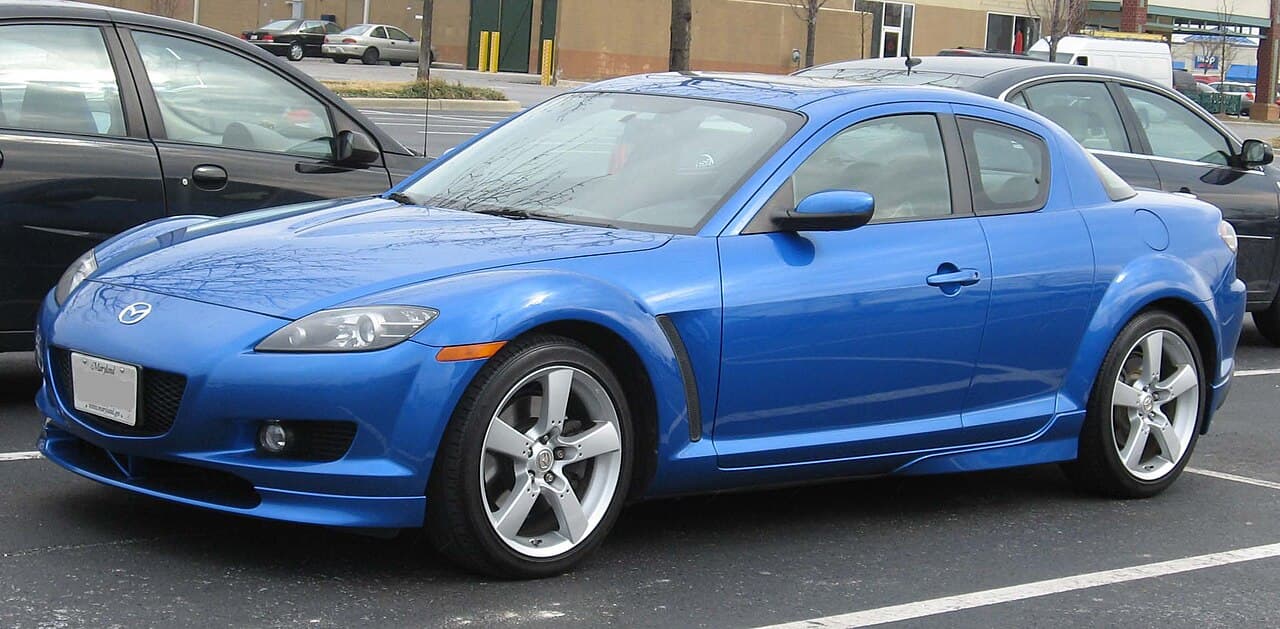
 2003–2012SE3PSE3P1.3 rotary petrolPetrolSee faults & what to checkPhoto: IFCAR via Wikimedia Commons, Public domain.
Mazda2003–2012 Critical issues documented
Mazda RX-8: common faults & what to check
Thinking about buying a used Mazda RX-8 (2003–2012) in New Zealand? We've documented 15 known faults for this model spanning engine, cooling, suspension, and fluid leaks. Each researched and verified before it's published. The most serious issues here are rated critical. Every one is listed below with its symptoms and repair cost, and each has its own page with where to look and what to ask the seller. Free, no account needed.
Check this exact Mazda RX-8
- Odometer history
- Money owing
- Reported stolen
- Ownership history
15
Critical
$450–$1,300
6
Which Mazda RX-8 are you looking at?
Petrol
2003–2012SE3PSE3P1.3 rotary petrolPetrolSee faults & what to checkPhoto: IFCAR via Wikimedia Commons, Public domain.Now narrow it to the engine
Start your free check on this Mazda RX-8
Mazda RX-8
Likely — same engine family
Mazda RX-8
Narrowed by capacity and fuel. No engine code is recorded for this option, so a fault specific to one engine of that size cannot be confirmed from it.
Matched on capacity and fuel, not on an engine code.
- 1 documented fault names an engine this selection cannot confirm. It is listed separately below.
matched on 1.3L engine
What to look out for
Serious issue
Start the engine cold and warm it fully to operating temperature, then shut it off.
Apex Seal Failure from Carbon Buildup and Short-Trip Use
The Renesis 13B-MSP rotary engine's apex seals are the single most documented failure point across all RX-8 production years. Carbon deposits accumulate on the rotor housing and apex seal grooves from short-trip driving, incomplete warm-up cycles, or oil injection system neglect. Seals lose their ability to maintain compression, resulting in engine that fails to start hot, produces white/blue smoke, and eventually cannot run. This failure pattern is so prevalent it defines the RX-8's reputation and must be tested at purchase.
What you would notice
Serious issue
Inspect all coolant hoses for swelling, cracking, or soft spots — squeeze firmly along the entire length.
Cooling System Failure and Overheating
The 13B-MSP Renesis is extremely sensitive to overheating — even a single overheat event can distort the aluminium rotor housings and cause apex seal failure. Documented cooling system faults include: cracking or swelling of coolant hoses (particularly lower radiator and heater core hoses), thermostat failure causing the engine to run hot before the gauge visibly rises, water pump seal failure, and radiator blockage from degraded coolant. The side-exhaust port design of the Renesis places exhaust ports immediately adjacent to coolant passages, making the engine more vulnerable to localised heat damage than a comparable piston engine. Overheating is the second leading cause of apex seal failure after flooding.
What you would notice
Serious issue
Inspect the ball joint rubber boot for cracking, splitting, or grease loss — a compromised boot accelerates joint wear.
Front Lower Control Arm Ball Joint Wear
The RX-8 SE3P uses a double-wishbone front suspension with a pressed-in ball joint at the outer end of the lower control arm. This ball joint carries significant lateral and braking loads and wears progressively with age and mileage. New Zealand and Australian road conditions — including unsealed or potholed urban roads — accelerate wear. A worn ball joint introduces vague, imprecise steering, causes tyre wear on the inner edge, and in extreme cases can separate, resulting in sudden loss of directional control. Ball joint condition is a standard WOF inspection item in New Zealand, and failure is a common reason for a failed warrant on higher-mileage RX-8s.
What you would notice
Serious issue
Verify OMP operation via live data scan if possible.
Oil Metering Pump (OMP) Failure
The Renesis engine does not lubricate its apex seals via conventional crankcase oil splash; instead a dedicated Oil Metering Pump (OMP) injects precise quantities of engine oil directly into the intake ports to lubricate the rotor housings and apex seals. OMP failure or blockage — often from sludge accumulation when the engine has been run with degraded or extended-interval oil — starves the apex seals of lubrication and causes rapid seal wear leading to engine failure. Some owners pre-emptively disable the OMP and pre-mix 2-stroke oil in the fuel, though this is not a Mazda-approved procedure and risks catalyst damage if incorrect ratios are used.
What you would notice
Costly issue
Ask specifically about no-start history.
Engine Flooding — Cold Start No-Start
The 13B-MSP Renesis is highly susceptible to fuel flooding when started cold and shut down before reaching full operating temperature. Unburned fuel saturates the spark plugs (the engine uses two plugs per face, four total), preventing ignition on the next start attempt. Unlike piston engines, the rotary cannot expel flooded fuel through normal cranking without risk of hydrolocking or catalytic converter damage. Mazda issued a Technical Service Bulletin addressing the cold-start procedure and the minimum warm-up requirement. This is an inherent design characteristic of the engine that is exacerbated by poor ownership habits.
What you would notice
Costly issue
Ask about oil top-up routine and premixing, check catalytic converter for restriction or rattle, and review plug/coil maintenance.
Oil consumption by design and catalytic converter clogging
The rotary intentionally injects oil to lubricate seals, so it consumes oil by design and must be topped up; owners often premix too. Unburnt oil and rich running clog the catalytic converter, which can then break down and cause damage.
What you would notice
See all 15 documented issues
Engine, transmission & cooling4 critical
01Apex Seal Failure from Carbon Buildup and Short-Trip Use
02Coolant System Water Pump Seal and Impeller Failure
03Cooling System Failure and Overheating
04Oil Metering Pump (OMP) Failure
OccasionalEngine $300–$900 to fix
The Renesis engine does not lubricate its apex seals via conventional crankcase oil splash; instead a dedicated Oil Metering Pump (OMP) injects precise quantities of engine oil directly into the intake ports to lubricate the rotor housings and apex seals. OMP failure or blockage — often from sludge accumulation when the engine has been run with degraded or extended-interval oil — starves the apex seals of lubrication and causes rapid seal wear leading to engine failure. Some owners pre-emptively disable the OMP and pre-mix 2-stroke oil in the fuel, though this is not a Mazda-approved procedure and risks catalyst damage if incorrect ratios are used.
Symptoms to notice
What to check
Ask the seller
05Oil consumption by design and catalytic converter clogging
CommonEngine $300–$2,500 to fix
The rotary intentionally injects oil to lubricate seals, so it consumes oil by design and must be topped up; owners often premix too. Unburnt oil and rich running clog the catalytic converter, which can then break down and cause damage.
Symptoms to notice
What to check
Ask the seller
06Renesis Engine Flooding on Hot Restart
07Engine Flooding — Cold Start No-Start
Electrical
08Electric Power Steering Motor and Control Unit Failure
OccasionalElectrical $850–$2,600 to fix
The RX-8 SE3P uses a column-mounted electric power steering (EPS) system with a brushed DC assist motor and a dedicated EPS control module. The assist motor and its internal brush gear are susceptible to wear and thermal degradation over time and mileage, particularly under repeated low-speed parking use which places maximum load on the motor. Failure modes include motor brush wear, motor winding failure, and EPS control module faults — all resulting in loss of power assistance. The driver must then steer with full manual effort, which is unusually high on the RX-8 at low speed due to its front weight distribution. NHTSA received a volume of complaints on this failure.
Symptoms to notice
What to check
Ask the seller
09Renesis Leading & Trailing Ignition Coil Failure
10Ignition Coilpack Failure (Mazda Recall Issued)
11Starter Motor Failure from Repeated Flooding De-Flood Cycles
OccasionalElectrical $450–$1,000 to fix
The de-flood procedure for a flooded Renesis engine requires cranking the engine at full throttle for 20–30 seconds with the fuel injection disabled. This thermal and mechanical stress cycle is much more severe than normal starting loads. Series 2 RX-8 starter motors show accelerated wear and failure on cars that have been flooded multiple times, leading to slow cranking, no-start on hot days, or complete failure. The starter motor is also stressed by the rotary engine's comparatively high compression cranking resistance.
Symptoms to notice
What to check
Ask the seller
Body, brakes, suspension & interior1 critical
12Front Lower Control Arm Ball Joint Wear
CommonSuspension $400–$950 to fix
The RX-8 SE3P uses a double-wishbone front suspension with a pressed-in ball joint at the outer end of the lower control arm. This ball joint carries significant lateral and braking loads and wears progressively with age and mileage. New Zealand and Australian road conditions — including unsealed or potholed urban roads — accelerate wear. A worn ball joint introduces vague, imprecise steering, causes tyre wear on the inner edge, and in extreme cases can separate, resulting in sudden loss of directional control. Ball joint condition is a standard WOF inspection item in New Zealand, and failure is a common reason for a failed warrant on higher-mileage RX-8s.
 Example of the part — not this vehicle
A separated lower ball joint: the control arm has dropped and the wheel has splayed out under the guard.
Symptoms to notice
What to check
Ask the seller
Fluid leaks
1313B-MSP Side Seal & Rotor Housing Gasket Oil Seep
OccasionalFluid Leaks $2,000–$6,500 to fix
The side seals on the Renesis rotor face periphery, along with the O-rings and gaskets sealing the rotor housing joint faces, degrade with heat cycling and age, allowing engine oil to seep externally from the housing mating surfaces. This presents as oily residue on the engine block sides, at the bellhousing junction, and on lower engine surfaces. External oil leaks increase fire risk, accelerate oil consumption beyond the expected OMP injection rate, and may mask total oil loss in a car already prone to oil-related issues. Resolution requires a full rotary engine reseal involving disassembly of the eccentric shaft and rotor housing stack to replace side seals, O-rings, and housing gaskets.
Symptoms to notice
What to check
Ask the seller
14Power Steering Pump Failure and Fluid Leakage
OccasionalFluid Leaks $700–$1,800 to fix
The hydraulic power steering pump on Series 1 RX-8 models is a documented failure point, with pumps failing from internal vane and seal wear, particularly on high-mileage cars. Failure results in heavy steering, pump noise, and eventual fluid loss. The location of the pump close to exhaust heat on the rotary layout contributes to seal degradation. Some examples develop weeping seals before full pump failure.
Symptoms to notice
What to check
Ask the seller
Depends on which engine this Mazda RX-8 has — 1
Engine, transmission & cooling
01Clutch and Flywheel Chatter on Manual Transmission
Can't confirm for this car
OccasionalTransmission $1,400–$3,000 to fix
Can't confirm for this car
Series 2 RX-8 manual transmission cars develop clutch chatter from a combination of a lightweight flywheel and clutch friction material that glazes under the low torque / high-rev character of the rotary engine. Chatter is particularly evident on smooth take-off at low speed. The dual-mass flywheel (where fitted) can develop internal wear causing additional vibration. This is a wear item but accelerated by short-trip use and improper clutch slip technique.
Symptoms to notice
What to check
Ask the seller
Mazda RX-8 faults in detail
Apex Seal Failure from Carbon Buildup and Short-Trip UseCoolant System Water Pump Seal and Impeller FailureCooling System Failure and OverheatingEngine Flooding — Cold Start No-StartIgnition Coilpack Failure (Mazda Recall Issued)Renesis Engine Flooding on Hot RestartRenesis Leading & Trailing Ignition Coil Failure
Other Mazda models
Mazda RX-8 buyer questions
Is the Mazda RX-8 reliable?
Like any used car, it depends on the specific example and its service history. Across the 15 documented faults for the Mazda RX-8, the recurring problem areas are engine, cooling, and suspension. A Mazda RX-8 with a full service history and no signs of the issues listed on this page can be a sound buy but each one needs to be checked individually before you commit.
What are the most common problems with a used Mazda RX-8?
We've catalogued 15 known faults for the Mazda RX-8, covering engine, cooling, and suspension. All 15 are written out in full on this page, with the symptoms to notice, what to inspect, and typical repair costs for each. Free to read, no account needed.
How much do repairs cost on a Mazda RX-8?
Most single repairs on the Mazda RX-8 fall between $450–$1,300 at NZ independent-workshop rates. Some of the 15 documented faults cost less and a few cost considerably more, and no one car needs them all. Knowing which ones to look for before you view is what lets you negotiate the price down or walk away.
Should I get a pre-purchase inspection on a Mazda RX-8?
Yes. A Mazda RX-8 inspection focused on its known weak points is the single best way to avoid an expensive mistake. KickTyres gives you a guided, model-specific inspection plus a market valuation and negotiation figure for $24.90 far less than the cost of missing one of the faults on this page.