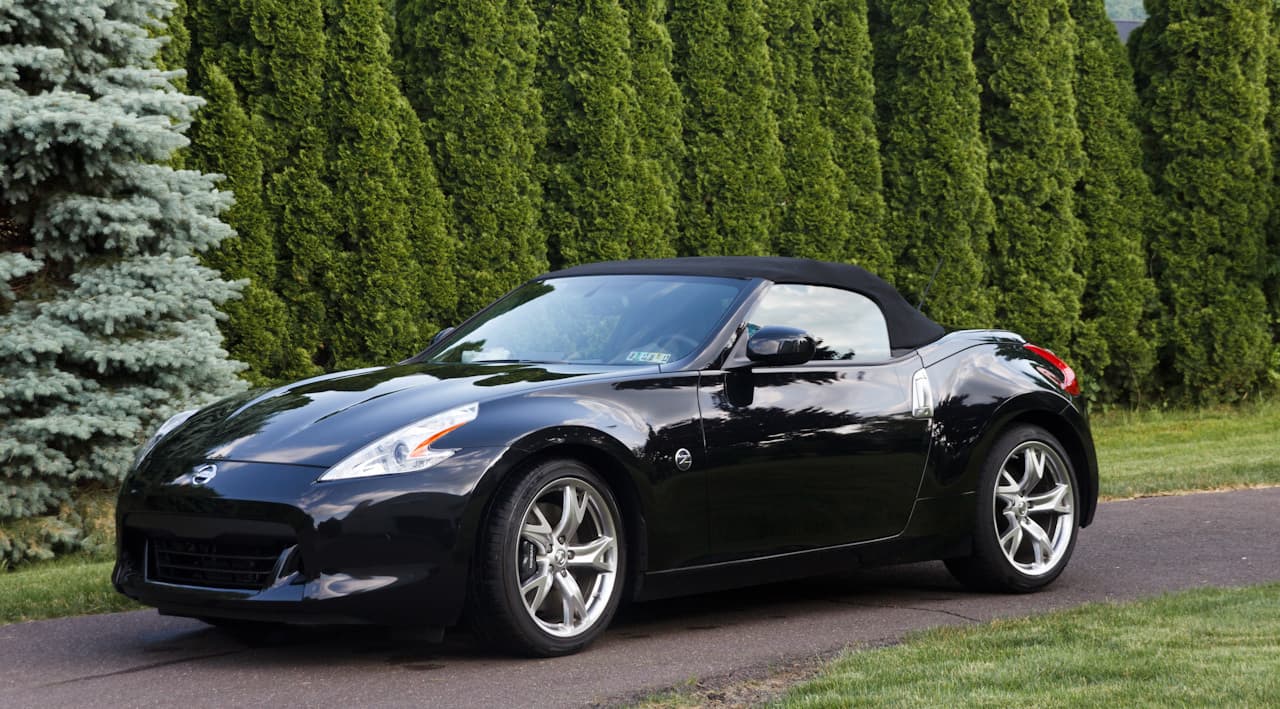
 2009–2021Z34 SelectedZ34Engine not documented for this generationEngine not documentedSee faults & what to checkPhoto: betancourt via Wikimedia Commons, CC BY 2.0.
Nissan2002–2021 Critical issues documented
Nissan 350Z Z34: common faults & what to check
The Z34 is the Nissan 350Z built 2009–2021. Of the 12 faults documented for the 350Z, 5 apply to this generation, each with its symptoms, what to inspect and a typical repair cost. Free, no account needed.
Check this exact Nissan 350Z
- Odometer history
- Money owing
- Reported stolen
- Ownership history
12
Critical
$500–$1,200
5
You're looking at the Z34
2009–2021Z34 SelectedZ34Engine not documented for this generationEngine not documentedSee faults & what to checkPhoto: betancourt via Wikimedia Commons, CC BY 2.0.Now narrow it to the engine
A 2010 Nissan 350Z is the Z34 generation (2009 to 2021).
We cannot narrow the engine list to this year, so every engine this model was sold with is offered.
Start your free check on this Nissan 350Z
Pick the engine above first: the 350Z came with 2, and without it the report has to show all of their faults. Pick the engine
Can't confirm for this car
Nissan 350Z · 2010
Narrowed to the year. No engine is recorded for this vehicle. Pick an engine to see which faults apply.
Tell us the engine, or check the engine code on the car, before relying on this.
- No engine is recorded for this vehicle.
matched on year only
What to look out for
Serious issue
Watch for: Clunking or knocking from the front suspension when traversing speed bumps, pot holes or during parking manoeuvres.
Front Lower Control Arm Ball Joint Wear
The Z33 and Z34 front suspension uses pressed-in ball joints in the lower control arms. Road grit, moisture and the high cornering loads generated by the stiff suspension geometry accelerate wear of the ball joint socket and bearing surface. As clearance increases the joint develops axial play, which allows the knuckle to move unpredictably under braking and cornering loads — a safety-critical failure mode. In advanced cases the joint can separate, resulting in immediate loss of steering and wheel collapse; many WoF inspection failures on higher-mileage Z33s cite front ball joint play as the rejection reason.
What you would notice
Costly issue
Watch for: Vehicle pulling to one side under moderate or heavy braking, with the pull becoming more pronounced as the brakes heat up.
Brake Caliper Guide Pin Seizure
The front and rear brake calipers on the Z33 and Z34 use sliding guide pins that allow the caliper body to float and apply equal clamping force to both brake pads. In New Zealand's coastal and wet-road environment, road salt and water ingress corrode the guide pin bores in the caliper bracket, causing the pins to seize in position. A seized guide pin prevents the outboard pad from releasing fully after brake application, creating continuous rotor contact that causes accelerated pad and rotor wear, elevated brake fluid temperatures, and progressive braking pull toward the seized side. Rear calipers are disproportionately affected because they also incorporate the electric park brake mechanism, which further complicates disassembly.
What you would notice
See all 5 issues for this one
Body, brakes, suspension & interior1 critical
01Front Lower Control Arm Ball Joint Wear
CommonSuspension $500–$1,600 to fix
The Z33 and Z34 front suspension uses pressed-in ball joints in the lower control arms. Road grit, moisture and the high cornering loads generated by the stiff suspension geometry accelerate wear of the ball joint socket and bearing surface. As clearance increases the joint develops axial play, which allows the knuckle to move unpredictably under braking and cornering loads — a safety-critical failure mode. In advanced cases the joint can separate, resulting in immediate loss of steering and wheel collapse; many WoF inspection failures on higher-mileage Z33s cite front ball joint play as the rejection reason.
 Example of the part — not this vehicle
A separated lower ball joint: the control arm has dropped and the wheel has splayed out under the guard.
Symptoms to notice
What to check
Ask the seller
02Rear Multi-Link Suspension Bush Collapse
CommonSuspension $900–$3,500 to fix
The Z33 and Z34 rear suspension is a sophisticated five-link independent layout with rubber-bonded bushes at each arm pivot point. The toe-link and inner lateral link bushes are particularly vulnerable to degradation because they carry high longitudinal loads and are positioned close to hot exhaust components in the tunnel area. As the rubber compounds harden, crack or debond from the outer sleeve, the arms lose their intended geometry compliance and the rear axle develops uncontrolled toe changes under braking and acceleration. The result is a rear end that feels nervous or loose on corner exit, and the failure is frequently misdiagnosed as shock absorber wear before alignment data reveals the root cause.
Symptoms to notice
What to check
Ask the seller
03Brake Caliper Guide Pin Seizure
CommonBrakes $250–$1,200 to fix
The front and rear brake calipers on the Z33 and Z34 use sliding guide pins that allow the caliper body to float and apply equal clamping force to both brake pads. In New Zealand's coastal and wet-road environment, road salt and water ingress corrode the guide pin bores in the caliper bracket, causing the pins to seize in position. A seized guide pin prevents the outboard pad from releasing fully after brake application, creating continuous rotor contact that causes accelerated pad and rotor wear, elevated brake fluid temperatures, and progressive braking pull toward the seized side. Rear calipers are disproportionately affected because they also incorporate the electric park brake mechanism, which further complicates disassembly.
Symptoms to notice
What to check
Ask the seller
Depends on the exact engine — 2 more
Engine, transmission & cooling
01Rear LSD Fluid Degradation and Differential Chatter
Can't confirm for this car
CommonTransmission $150–$500 to fix
Can't confirm for this car
The 370Z Sport and NISMO variants carry a factory mechanical limited-slip differential whose friction modifier additives degrade with heat cycling and mileage. Degraded fluid causes the characteristic LSD chatter during low-speed tight-radius turning as the clutch packs bind rather than slip smoothly. The differential fluid is frequently overlooked as owners assume a lifetime fill — it is not. Correct-spec fluid with friction modifier additive resolves chatter in all but severely worn differentials.
Symptoms to notice
What to check
Ask the seller
02Manual Transmission Clutch Pressure Plate Cracking
Can't confirm for this car
OccasionalTransmission $1,500–$3,800 to fix
Can't confirm for this car
The 6-speed manual Z33 and Z34 use a single-disc clutch assembly where the pressure plate diaphragm spring fingers and the pressure ring itself are subject to thermal stress cracking under hard use. The factory clutch is calibrated for street loads, and repeated high-rpm launches or track sessions generate heat that exceeds the pressure plate's thermal tolerance, causing fatigue cracks to develop at the diaphragm spring fulcrum ring. Cracked pressure plates produce increasingly erratic engagement as the clamping load becomes uneven, and in severe cases the pressure ring or a diaphragm finger can fracture and damage the flywheel, bell housing or gearbox input shaft bearing.
Symptoms to notice
What to check
Ask the seller
Other Nissan 350Z engines and years
Engine, transmission & cooling
01VQ35DE Secondary Timing Chain Stretch
Does not apply
CommonEngine $1,800–$3,200 to fix
Does not apply
The VQ35DE (2002-2006, pre-HR) uses secondary timing chains linking the primary chain to the exhaust camshafts. These secondary chains are prone to stretch under the dual-overhead-cam load, particularly with irregular oil change intervals. Stretched chains cause cam timing retardation, triggering P0011/P0021 cam position sensor fault codes and loss of power. If left unattended the chain can jump a tooth or fail catastrophically. The VQ35HR (2006-2009) redesigned the secondary chain routing and largely resolved this.
 Example of the part — not this vehicle
The front of a twin-cam engine with the timing cover off — chain, sprockets and guides.
Symptoms to notice
What to check
Ask the seller
02VQ35DE/VQ37VHR Timing Chain Primary and Secondary Tensioner Rattle
Does not apply
CommonEngine $1,800–$5,500 to fix
Does not apply
The VQ35DE uses a three-chain layout: one primary chain driving an intermediate shaft, and two secondary chains feeding each camshaft bank. The hydraulic tensioners, particularly the secondary units, lose oil pressure after cold soaks because the check valves allow oil to drain back to the sump overnight. On the VQ37VHR the arrangement is similar, and tensioner oil galleries are narrow enough that marginal oil viscosity or extended drain intervals starve the tensioner pistons, allowing chain slack to slap the plastic guide rails. Prolonged operation in this condition wears the guides, which can shed debris into the sump and eventually allow chain jump or guide rail breakage.
Example of the part — not this vehicleThe front of a twin-cam engine with the timing cover off — chain, sprockets and guides.
Symptoms to notice
What to check
Ask the seller
03Concentric Clutch Slave Cylinder (CSC) Internal Failure
Does not apply
CommonTransmission $500–$1,100 to fix
Does not apply
The Z33 six-speed manual uses a concentric slave cylinder (CSC) mounted inside the bell housing, concentric with the gearbox input shaft. When this unit fails it cannot be inspected without full transmission removal. The CSC seal deteriorates and leaks hydraulic fluid internally, causing clutch disengagement failure or a progressively spongy pedal. Because replacement requires dropping the gearbox, labour costs are disproportionately high relative to the part cost. This is a well-documented weak point across all Z33 manual variants.
Symptoms to notice
What to check
Ask the seller
04VQ35 Cam Chain Tensioner Cold-Start Rattle
Does not apply
Very commonEngine $350–$700 to fix
Does not apply
The primary cam chain tensioners on the VQ35DE and VQ35HR engines lose oil pressure after extended engine-off periods. On cold start the tensioner takes several seconds to pressurise, allowing chain slack that produces a loud metallic rattle from the front of the engine. Repeated episodes accelerate chain and guide wear. Most evident in high-mileage examples and vehicles that sit unused for days.
Example of the part — not this vehicleThe front of a twin-cam engine with the timing cover off — chain, sprockets and guides.
Symptoms to notice
What to check
Ask the seller
05Rear LSD Fluid Degradation and Chatter
Does not apply
CommonTransmission $150–$600 to fix
Does not apply
The factory Torsen or clutch-pack limited-slip differential fitted to most 350Z variants degrades its friction modifier additives with heat cycling and use. Worn or wrong-spec fluid causes a characteristic chattering or clunking sensation when the diff engages during low-speed turning manoeuvres such as parking lot U-turns. The condition is usually resolved with a drain-and-refill using Nissan-spec friction modifier additive, but long-neglected diffs can develop worn clutch packs requiring a rebuild.
Symptoms to notice
What to check
Ask the seller
Fluid leaks
01Power Steering Rack Seal Leaks
Does not apply
CommonFluid Leaks $700–$1,800 to fix
Does not apply
The hydraulic rack-and-pinion power steering unit on the Z33 develops internal seal deterioration with age, causing power steering fluid to weep from the rack ends and pinion seal. Fluid loss leads to low-fluid groaning on lock-to-lock turns and, if ignored, causes rack scoring and eventual full failure. Leaking fluid also contaminates the front subframe area. A rebuild is feasible but many workshops replace the rack as a unit.
Symptoms to notice
What to check
Ask the seller
02VQ35 Valve Cover Gasket Oil Leaks
Does not apply
Very commonFluid Leaks $400–$750 to fix
Does not apply
The VQ35 engine uses four valve covers (two per bank on the DOHC layout). The cork-and-rubber gaskets harden and crack with age, producing oil leaks that run down onto exhaust manifolds and the bell housing. Leaks are near-universal on unmaintained high-mileage examples. The upper and lower covers each have separate gaskets. Labour is moderate as covers require intake plenum removal on some variants.
Symptoms to notice
What to check
Ask the seller
What these repairs cost on other cars
Some of the Nissan 350Z’s documented faults are repairs other models share. Each page lists the documented NZ cost for every model it affects.
Other Nissan models
Nissan 350Z buyer questions
Is the Nissan 350Z reliable?
Like any used car, it depends on the specific example and its service history. Across the 12 documented faults for the Nissan 350Z, the recurring problem areas are engine, suspension, and transmission. A Nissan 350Z with a full service history and no signs of the issues listed on this page can be a sound buy but each one needs to be checked individually before you commit.
What are the most common problems with a used Nissan 350Z?
We've catalogued 12 known faults for the Nissan 350Z, covering engine, suspension, and transmission. All 12 are written out in full on this page, with the symptoms to notice, what to inspect, and typical repair costs for each. Free to read, no account needed.
How much do repairs cost on a Nissan 350Z?
Most single repairs on the Nissan 350Z fall between $500–$1,200 at NZ independent-workshop rates. Some of the 12 documented faults cost less and a few cost considerably more, and no one car needs them all. Knowing which ones to look for before you view is what lets you negotiate the price down or walk away.
Should I get a pre-purchase inspection on a Nissan 350Z?
Yes. A Nissan 350Z inspection focused on its known weak points is the single best way to avoid an expensive mistake. KickTyres gives you a guided, model-specific inspection plus a market valuation and negotiation figure for $24.90 far less than the cost of missing one of the faults on this page.