 1998–2003R34R342.5L petrol (RB25-DET)PetrolSee faults & what to checkPhoto: Tokumeigakarinoaoshima via Wikimedia Commons, CC BY-SA 4.0.
Nissan1989–2023 Critical issues documented
Nissan Skyline: common faults & what to check
Thinking about buying a used Nissan Skyline (1989–2023) in New Zealand? We've documented 41 known faults for this model spanning engine, electrical, fluid leaks, and suspension. Each researched and verified before it's published. The most serious issues here are rated critical. Every one is listed below with its symptoms and repair cost, and each has its own page with where to look and what to ask the seller. Free, no account needed.
Check this exact Nissan Skyline
- Odometer history
- Money owing
- Reported stolen
- Ownership history
41
Critical
$700–$2,400
8
Which Nissan Skyline are you looking at?
Petrol
1998–2003R34R342.5L petrol (RB25-DET)PetrolSee faults & what to checkPhoto: Tokumeigakarinoaoshima via Wikimedia Commons, CC BY-SA 4.0.1998–2003R34R342.6L petrol (RB26-DETT)PetrolSee faults & what to checkPhoto: Tokumeigakarinoaoshima via Wikimedia Commons, CC BY-SA 4.0.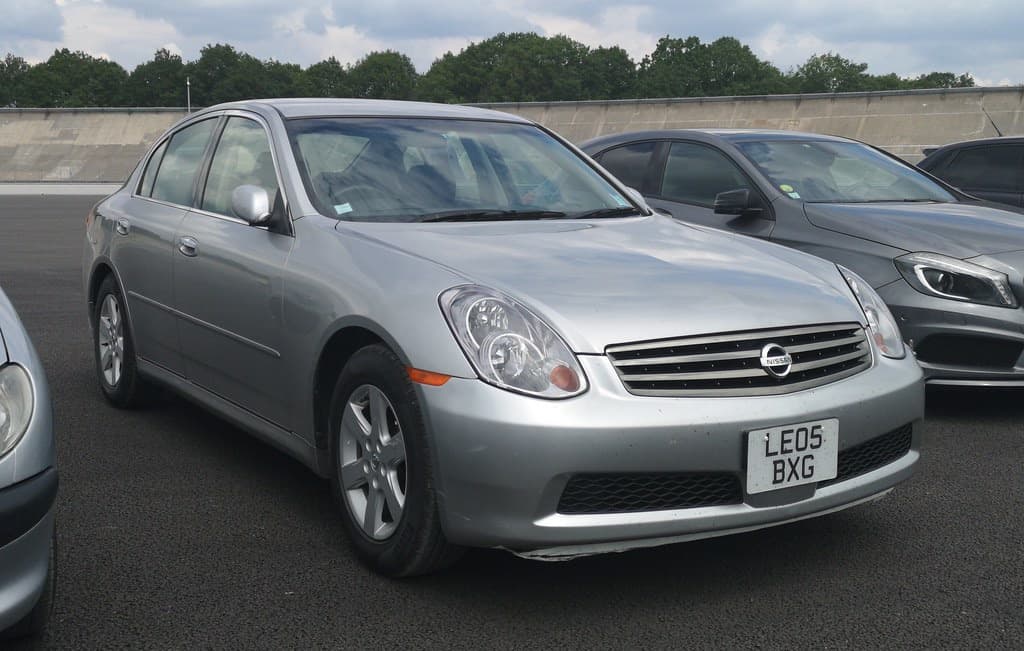 2001–2008V35V352.5 V6 petrolPetrolSee faults & what to checkPhoto: Guillaume Vachey from Chalon sur Saone, France via Wikimedia Commons, CC0.2001–2008V35V353.5 V6 petrolPetrolSee faults & what to checkPhoto: Guillaume Vachey from Chalon sur Saone, France via Wikimedia Commons, CC0.
 2006–2015V36V362.5 V6 petrolPetrolSee faults & what to checkPhoto: TTTNIS via Wikimedia Commons, Public domain.2006–2015V36V363.7 V6 petrolPetrolSee faults & what to checkPhoto: TTTNIS via Wikimedia Commons, Public domain.
 2013–nowV37V372.0 turbo petrolPetrolSee faults & what to checkPhoto: TTTNIS via Wikimedia Commons, CC0.
Hybrid
2013–nowV37V373.5 hybridHybridSee faults & what to checkPhoto: TTTNIS via Wikimedia Commons, CC0.Fuel not stated
2013–nowV37V373.0 twin-turbo V6Fuel not statedSee faults & what to checkPhoto: TTTNIS via Wikimedia Commons, CC0.Engine not documented
 1989–1995R32R32Engine not documented for this generationEngine not documentedSee faults & what to checkPhoto: Bull-Doser via Wikimedia Commons, Public domain.
 1993–1999R33R33Engine not documented for this generationEngine not documentedSee faults & what to checkPhoto: OSX via Wikimedia Commons, Public domain.
Now narrow it to the engine
2.0L petrol (RB20-DET)· 2.0 litre petrol2.5L petrol (RB25-DET)· 2.5 litre petrol2.5L petrol (VQ25-HR)· 2.5 litre petrol2.6L petrol (RB26-DETT)· 2.6 litre petrol3.0L petrol (VR30-DDTT)· 3.0 litre petrol3.5L petrol (VQ35-DE)· 3.5 litre petrol3.5L petrol (VQ35-HR)· 3.5 litre petrol3.7L petrol (VQ37-VHR)· 3.7 litre petrol
Start your free check on this Nissan Skyline
Nissan SkylineEngine not picked yet
Pick the engine above first: the Skyline came with 8, and without it the report has to show all of their faults. Pick the engine
Can't confirm for this car
Nissan Skyline
Nothing has been narrowed yet, so nothing below is a claim about a particular car. Pick a year and an engine to see which faults apply.
Tell us the engine, or check the engine code on the car, before relying on this.
matched on no vehicle context
What to look out for
Serious issue
Check the interior of the compressor housing for oil coating.
Turbo Oil Drain Line Coking — Bearing Starvation
On RB25DET and RB26DETT applications the turbocharger oil drain line routes from the turbo centre section back to the block via a steel tube with rubber connecting sections. When the engine is shut down hot, residual heat soaks the oil sitting static inside the drain tube; over thousands of heat cycles the oil carbonises and deposits build up (known as coking), progressively restricting the drain bore. A restricted drain causes oil to back up in the centre-section bearing housing, raises shaft seal pressure, forces oil past the compressor and turbine seals (blue smoke on overrun), and ultimately starves the floating bearings on cold start when the oil pressure supply exceeds the impeded drain. Bearing failure from oil starvation on shutdown is the terminal outcome and can destroy the turbo shaft into the compressor wheel.
What you would notice
Serious issue
Inspect the ball joint boot for splitting, cracking, or absence of the protective rubber.
V35/V36 Front Lower Control Arm Ball Joint Failure
The front lower control arms on V35 and V36 Skylines use pressed-in ball joints that are integral to the arm on many variants, requiring full arm replacement when the ball joint wears rather than allowing a simple joint swap. The ball joint boot seal degrades with age and road contamination, allowing grease to escape and moisture and grit to enter the joint. Once the lubricant is contaminated the ball stud wears rapidly, developing excessive axial and radial play. A worn ball joint changes front wheel camber and castor dynamically under cornering and braking loads, producing vague steering and tyre scrub. In advanced wear the joint can separate, causing sudden and catastrophic loss of front wheel geometry control. The V35 used in New Zealand's climate accelerates boot degradation due to gravel road dust and seasonal temperature swings.
What you would notice
Serious issue
Establish whether the turbo is standard ceramic or an upgraded steel/aftermarket unit, and what boost it runs.
RB25DET ceramic turbine shatter on GT-T (R34)
The turbocharged R34 GT-T runs the RB25DET NEO whose factory turbo (on many variants) uses a brittle ceramic exhaust turbine wheel. Under detonation, too much boost, or even repeatedly bouncing off the rev limiter, the ceramic wheel can snap off the shaft and the debris destroys the turbo, sometimes ingesting into the engine. Because so many R34s were tuned or thrashed, an original, un-upgraded ceramic turbo on a modified car is a real risk. A steel-wheel upgrade is the common fix.
What you would notice
Serious issue
Pull the sump at purchase if mileage is unknown or high.
RB26DETT Oil Pump Pickup Tube Screen Clog
The oil pump pickup tube mesh screen on the RB26DETT progressively clogs with carbon sludge and metallic debris at high mileage, restricting oil flow to the pump. This causes a rapid drop in oil pressure at high RPM that can lead to bearing failure within minutes. Most common in engines maintained on non-synthetic oil or where the sump has never been cleaned out. Well-documented across GT-R owner communities in NZ and Japan.
What you would notice
Serious issue
Confirm whether the vehicle has DAS (steer-by-wire) by checking the steering column for absence of a direct mechanical shaft feel at low speed.
Direct Adaptive Steering (DAS) Steer-by-Wire Intermittent Loss of Assist
Skyline V37 models equipped with the optional Direct Adaptive Steering (DAS) system use a full steer-by-wire architecture with no mechanical column connection in normal operation. NHTSA opened an investigation (PE14-016) into Infiniti Q50 DAS systems following multiple complaints of intermittent steering effort loss and unexpected steering direction changes at speed. The system defaults to a backup mechanical mode when the electronic actuator faults, but the transition can be abrupt and surprising to the driver. Actuator motor failures and ECU software faults have been documented. Some vehicles received software updates; others required steering actuator replacement. The system's complexity makes independent repair difficult.
What you would notice
Serious issue
With the engine running at idle, carefully observe the front crankshaft pulley from a safe distance for any wobble or eccentricity.
RB Engine Front Crankshaft Pulley Separation (RB25/RB26)
The front crankshaft harmonic balancer/pulley on RB25DET and RB26DETT engines is a bonded rubber-damper unit. The rubber bonding layer between the inner hub and outer pulley ring degrades and separates with age, particularly on engines that have been subject to high RPM use. When the outer ring separates it mis-times the alternator, power steering, and AC belt drive; if it contacts surrounding components it can destroy the front timing cover or damage wiring looms. In worst-case separation events the pulley can be expelled from the engine bay entirely. This is a known failure on aged high-km RB engines and is considered a critical safety item.
What you would notice
See all 41 documented issues
Depends on which engine this Nissan Skyline has — 41
Engine, transmission & cooling
01RB25DET Turbo Oil Feed Banjo Bolt Screen Restriction (Stagea C34)
Can't confirm for this car
CommonEngine $2,200–$5,500 to fix
Can't confirm for this car
The banjo bolt screen on the RB25DET turbocharger oil feed line becomes partially or fully blocked by carbon deposits and sludge, starving the turbo of lubrication. This is a well-documented failure mode on high-mileage RB25 engines, particularly those with infrequent oil changes or low-quality oil use. Turbo bearing failure follows, producing shaft play, oil burning and eventual seizure.
Symptoms to notice
What to check
Ask the seller
02Turbo Oil Drain Line Coking — Bearing Starvation
Can't confirm for this car03RB25DET ceramic turbine shatter on GT-T (R34)
Can't confirm for this car
OccasionalEngine $2,000–$5,000 to fix
Can't confirm for this car
The turbocharged R34 GT-T runs the RB25DET NEO whose factory turbo (on many variants) uses a brittle ceramic exhaust turbine wheel. Under detonation, too much boost, or even repeatedly bouncing off the rev limiter, the ceramic wheel can snap off the shaft and the debris destroys the turbo, sometimes ingesting into the engine. Because so many R34s were tuned or thrashed, an original, un-upgraded ceramic turbo on a modified car is a real risk. A steel-wheel upgrade is the common fix.
Symptoms to notice
What to check
Ask the seller
04RB26DETT Oil Pump Pickup Tube Screen Clog
Can't confirm for this car
OccasionalEngine $1,800–$4,500 to fix
Can't confirm for this car
The oil pump pickup tube mesh screen on the RB26DETT progressively clogs with carbon sludge and metallic debris at high mileage, restricting oil flow to the pump. This causes a rapid drop in oil pressure at high RPM that can lead to bearing failure within minutes. Most common in engines maintained on non-synthetic oil or where the sump has never been cleaned out. Well-documented across GT-R owner communities in NZ and Japan.
Symptoms to notice
What to check
Ask the seller
05RB Engine Front Crankshaft Pulley Separation (RB25/RB26)
Can't confirm for this car
OccasionalEngine $600–$1,800 to fix
Can't confirm for this car
The front crankshaft harmonic balancer/pulley on RB25DET and RB26DETT engines is a bonded rubber-damper unit. The rubber bonding layer between the inner hub and outer pulley ring degrades and separates with age, particularly on engines that have been subject to high RPM use. When the outer ring separates it mis-times the alternator, power steering, and AC belt drive; if it contacts surrounding components it can destroy the front timing cover or damage wiring looms. In worst-case separation events the pulley can be expelled from the engine bay entirely. This is a known failure on aged high-km RB engines and is considered a critical safety item.
Symptoms to notice
What to check
Ask the seller
06V37 turbo/hybrid complexity - limited NZ data
Can't confirm for this car
RareEngine $1,500–$6,000 to fix
Can't confirm for this car
The V37 Skyline (2014-on) moved to a Mercedes-derived 2.0 turbo (274-series), a twin-turbo 3.0 VR30DDTT, or a 3.5 hybrid, and very few have been imported to NZ so model-specific fault patterns here are thin. Overseas, the VR30DDTT has raised concerns around turbo oil-feed/coolant and the 2.0 turbo shares Mercedes M274 timing-chain and oil-consumption traits, but numbers are too low to call a characteristic NZ fault. Treat a V37 as a modern, complex, dealer-diagnosis car and insist on a marque specialist inspection.
Symptoms to notice
What to check
Ask the seller
07ATTESA-ETS AWD Transfer Case Oil Degradation (Stagea C34/M35)
Can't confirm for this car08RB20DET Turbocharger Compressor Wheel Wear
Can't confirm for this car09Rear Differential Coupling / eLSD Wear and Failure
Can't confirm for this car
OccasionalTransmission $1,500–$4,500 to fix
Can't confirm for this car
The V37 Skyline rear-wheel-drive platform uses an electronically-controlled rear differential with a multi-plate clutch coupling for torque vectoring or limited-slip function depending on specification. The coupling's friction clutch packs and the electronic actuator motor are wear items. Failure modes include clunking on tight low-speed turns, vibration under acceleration, and complete lockup or freewheeling of the rear diff coupling. Fluid degradation in the rear differential accelerates wear; the coupling fluid requires separate servicing from the gearbox. High-mileage grey imports from Japan that have not had rear diff fluid serviced are at elevated risk. A failed coupling actuator can cause an AWD or ATTESA warning light in all-wheel-drive variants.
Symptoms to notice
What to check
Ask the seller
10VQ timing chain / VTC actuator rattle (V35 & V36)
Can't confirm for this car11VR30DDTT Valve Stem Seal Oil Consumption
Can't confirm for this car12VQ37VHR Timing Chain Tensioner Wear and Rattle
Can't confirm for this car
OccasionalEngine $1,800–$4,000 to fix
Can't confirm for this car
The 3.7-litre VQ37VHR naturally aspirated V6 uses a timing chain system with hydraulic tensioners. At high mileage or following oil change neglect, the primary and secondary chain tensioners lose hydraulic pressure retention, causing timing chain slack. This manifests as a distinctive metallic rattle on cold start that lasts 2–10 seconds until oil pressure builds. Extended operation with slack chains can cause chain stretch, guide wear, and ultimately timing skew that results in misfires, fault codes, and in severe cases bent valves. The issue is most prevalent in higher-mileage JDM imports where oil change intervals may not be verifiable. The repair requires dropping the front of the engine to access timing components.
 Example of the part — not this vehicle
The front of a twin-cam engine with the timing cover off — chain, sprockets and guides.
Symptoms to notice
What to check
Ask the seller
13High oil consumption between services (3.5 VQ35DE, V35 350GT)
Can't confirm for this car14VQ37VHR VVEL Variable Valve Event and Lift Actuator Failure
Can't confirm for this car
OccasionalEngine $1,400–$3,800 to fix
Can't confirm for this car
The VVEL (Variable Valve Event and Lift) system fitted to the VQ37VHR uses a DC actuator motor and worm-gear mechanism on each cylinder bank to continuously vary both valve lift and duration. The actuator motor brushes and gear mechanism are prone to wear, and the control shaft needle bearings can corrode in humid climates, causing the system to lose position feedback. When the ECM detects an out-of-range actuator response it sets a fault and can restrict engine output to a limp mode to prevent mechanical damage.
Symptoms to notice
What to check
Ask the seller
15Automatic Transmission Torque Converter Shudder
Can't confirm for this car
CommonTransmission $400–$3,200 to fix
Can't confirm for this car
The RE5R05A 5-speed and RE7R01A 7-speed automatic transmissions used in V36 Skyline variants are susceptible to torque converter lock-up clutch shudder, typically triggered by degraded automatic transmission fluid breaking down the clutch friction modifier additive. The lock-up clutch engages at light throttle in higher gears to reduce slip losses; when the friction modifier is depleted the clutch transitions between slip and lock unpredictably, creating a characteristic high-frequency vibration that can be mistaken for a drivetrain imbalance. Continued operation accelerates clutch lining wear and contaminates the ATF with friction material debris, ultimately requiring converter replacement.
 Example of the part — not this vehicle
A torque converter, sectioned. The lock-up clutch inside is what shudders.
Symptoms to notice
What to check
Ask the seller
16R33 4-Speed Automatic Transmission Shift Solenoid Wear
Can't confirm for this car17VQ35DE Timing Chain Tensioner Cold Rattle
Can't confirm for this car
CommonEngine $950–$2,400 to fix
Can't confirm for this car
The hydraulic timing chain tensioner on the VQ35DE loses oil pressure after extended shutdown, allowing the chain to slap against the guide at cold start. At high mileage the tensioner ratchet pawl and primary chain guide wear significantly, causing persistent rattle that takes longer than 5 seconds to clear. Left unaddressed, chain stretch can advance to jump-tooth risk on the intake cam sprockets, leading to valve-to-piston contact. Most prevalent above 120,000 km on cars that have seen extended oil change intervals.
Example of the part — not this vehicleThe front of a twin-cam engine with the timing cover off — chain, sprockets and guides.
Symptoms to notice
What to check
Ask the seller
18VQ35HR/VQ25HR Timing Chain Tensioner Rattle on Cold Start
Can't confirm for this car
CommonEngine $900–$2,200 to fix
Can't confirm for this car
The hydraulic timing chain tensioners on the VQ35HR and VQ25HR engines rely on oil pressure to maintain chain tension. On cold start, the delay in oil pressure build-up allows the primary and secondary chain tensioners to momentarily lose hydraulic load, permitting the chain to slap against the guide rails. Prolonged neglect accelerates guide rail wear and risks chain jump, which causes catastrophic valve-to-piston contact on these interference engines.
Example of the part — not this vehicleThe front of a twin-cam engine with the timing cover off — chain, sprockets and guides.
Symptoms to notice
What to check
Ask the seller
19VQ35HR HPFP Cam Follower Wear (P0087)
Can't confirm for this car
OccasionalEngine $480–$1,600 to fix
Can't confirm for this car
The V37 Skyline uses the VQ35HR engine with Nissan's direct injection system relying on a high-pressure fuel pump (HPFP) driven by a dedicated lobe on the intake camshaft. The steel roller follower that transfers cam lobe motion to the HPFP plunger is prone to accelerated wear when oil change intervals are extended or low-viscosity oil outside specification is used. Follower wear reduces the stroke delivered to the pump, causing low rail pressure at high engine load and setting P0087 (fuel rail pressure below target). Severe wear allows metal debris to contaminate the fuel system and can score the cam lobe, adding a camshaft replacement to the repair.
Symptoms to notice
What to check
Ask the seller
20RB20 Water Pump Bearing Failure and Impeller Spin
Can't confirm for this car21RB25DET NEO Variable Cam Timing (VCT) Oil Control Solenoid Wear
Can't confirm for this car22RB25DET Coolant Thermostat Housing Cracking
Can't confirm for this car23VQ35/VQ37 oil consumption (V35 & V36)
Can't confirm for this car
CommonEngine $300–$3,000 to fix
Can't confirm for this car
The VQ V6s in the V35/V36 (and the 370GT's VQ37VHR) are known to consume oil as they age, sometimes noticeably before 150,000 km, from worn oil-control rings. Owners cite anything from a litre every 2,500 km to a litre every 1,000 km on worse examples. It is usually a manageable top-up habit, but an owner who doesn't check the level risks starving the timing chain and bearings. Blue smoke and a low dipstick are the tells.
Symptoms to notice
What to check
Ask the seller
24VR30DDTT Turbocharger Wastegate Actuator Rattle
Can't confirm for this car
CommonEngine $400–$2,200 to fix
Can't confirm for this car
The twin turbochargers on the VR30DDTT use electronically-controlled wastegate actuators. The actuator arm and pivot develop play over time, causing a metallic rattling noise that is most audible at cold idle and on deceleration. Nissan dealers documented this as a known characteristic in some service communications, but significant play can cause inconsistent boost control, leading to over-boost or under-boost conditions logged as fault codes. On high-mileage examples the actuator can seize in an open position, resulting in reduced power and turbo fault codes. Some affected units also exhibit compressor wheel contact with the housing (wheel rub) if turbo oil feed is neglected.
Symptoms to notice
What to check
Ask the seller
25GDI Intake Valve Carbon Buildup (VR30DDTT and VQ37VHR)
Can't confirm for this car
Very commonEngine $700–$1,700 to fix
Can't confirm for this car
Both the VR30DDTT and VQ37VHR engines use gasoline direct injection (GDI) without supplementary port injection. Because fuel is never sprayed over the intake valves, oil vapour from the PCV system accumulates on the back of the intake valves as hard carbon deposits. Over 60,000–100,000 km the deposits restrict airflow, cause rough idle, misfires, and reduced throttle response. The VQ37VHR is particularly susceptible due to its higher displacement and longer service history on NZ-imported examples. Walnut-blasting is the accepted remedy; carbon deposits cannot be dissolved by fuel additives once hardened.
Symptoms to notice
What to check
Ask the seller
26VR30DDTT Intercooler Charge Pipe Boost Leak
Can't confirm for this car
CommonEngine $250–$900 to fix
Can't confirm for this car
The VR30DDTT uses a front-mount intercooler system with silicone couplers and plastic charge pipes routing compressed air from the turbos to the throttle body. The factory silicone couplers and their retaining clamps are known to loosen or split under repeated heat cycling, causing boost leaks. A boost leak reduces power, triggers a lean mixture condition, and can cause misfires under load. The plastic sections of the charge pipe are also prone to cracking near mounting brackets on higher-mileage examples. On modified or tuned vehicles the factory boost pipes are an early failure point when boost pressure is increased above stock levels.
Symptoms to notice
What to check
Ask the seller
Electrical
01Direct Adaptive Steering (DAS) Steer-by-Wire Intermittent Loss of Assist
Can't confirm for this car
OccasionalElectrical $900–$3,500 to fix
Can't confirm for this car
Skyline V37 models equipped with the optional Direct Adaptive Steering (DAS) system use a full steer-by-wire architecture with no mechanical column connection in normal operation. NHTSA opened an investigation (PE14-016) into Infiniti Q50 DAS systems following multiple complaints of intermittent steering effort loss and unexpected steering direction changes at speed. The system defaults to a backup mechanical mode when the electronic actuator faults, but the transition can be abrupt and surprising to the driver. Actuator motor failures and ECU software faults have been documented. Some vehicles received software updates; others required steering actuator replacement. The system's complexity makes independent repair difficult.
Symptoms to notice
What to check
Ask the seller
02Electric Power Steering Failure
Can't confirm for this car
OccasionalElectrical $700–$2,500 to fix
Can't confirm for this car
EPS system can develop a fault causing loss of power assistance.
Symptoms to notice
What to check
Ask the seller
03RB26DETT Ignition Coilpack Failure (GT-R)
Can't confirm for this carBody, brakes, suspension & interior
01V35/V36 Front Lower Control Arm Ball Joint Failure
Can't confirm for this car
CommonSuspension $650–$1,900 to fix
Can't confirm for this car
The front lower control arms on V35 and V36 Skylines use pressed-in ball joints that are integral to the arm on many variants, requiring full arm replacement when the ball joint wears rather than allowing a simple joint swap. The ball joint boot seal degrades with age and road contamination, allowing grease to escape and moisture and grit to enter the joint. Once the lubricant is contaminated the ball stud wears rapidly, developing excessive axial and radial play. A worn ball joint changes front wheel camber and castor dynamically under cornering and braking loads, producing vague steering and tyre scrub. In advanced wear the joint can separate, causing sudden and catastrophic loss of front wheel geometry control. The V35 used in New Zealand's climate accelerates boot degradation due to gravel road dust and seasonal temperature swings.
 Example of the part — not this vehicle
A separated lower ball joint: the control arm has dropped and the wheel has splayed out under the guard.
Symptoms to notice
What to check
Ask the seller
02Rust at rear arches, sills and strut-tower seams (R34)
Can't confirm for this car
CommonBody & Rust $800–$4,000 to fix
Can't confirm for this car
R34 Skylines are now 20-plus years old and corrode in predictable places: the rear wheel-arch lips and inner arches, the sills, and - importantly - the engine-bay strut-tower seams, where bubbling signals structural rust. As values have climbed, cheap 'tidy' cars often hide arch and floor rust under filler. Structural corrosion is expensive to do properly and a WoF/cert problem.
Symptoms to notice
What to check
Ask the seller
03Rear Multi-Link Suspension Bush Collapse
Can't confirm for this car
CommonSuspension $700–$2,100 to fix
Can't confirm for this car
The V36 Skyline rear suspension uses a five-link multi-link arrangement with rubber-bonded bushes at each link mounting point. The inner and outer bushes in the rear lower lateral links and the toe-control link are particularly susceptible to hydrolytic degradation and cracking, especially in vehicles subjected to NZ road salt, temperature cycling, or sustained high loads. As the rubber deteriorates, the bush inner sleeve becomes decoupled from the outer shell, allowing the link geometry to shift under cornering and braking forces. This produces progressive rear steer behaviour, unpredictable oversteer on mid-corner bumps, and rapid rear tyre wear on the inner shoulder.
Symptoms to notice
What to check
Ask the seller
04Front Wheel Bearing Premature Wear (ATTESA AWD Stress)
Can't confirm for this car05Brake Caliper Guide Pin Seizure
Can't confirm for this car
CommonBrakes $180–$550 to fix
Can't confirm for this car
The V36 Skyline uses sliding-type brake calipers front and rear, which depend on two grease-lubricated guide pins per caliper to allow the caliper body to float and apply even clamping force across both brake pads. In New Zealand's climate, moisture ingress into the guide pin bores causes the steel pins to corrode and seize within their aluminium caliper carriers, preventing the caliper from retracting fully after brake application. The resulting brake drag causes accelerating heat build-up in the rotor and pad, leading to premature pad and rotor wear, vibration under braking from uneven rotor temperature, and in severe cases thermal cracking of the disc or brake fluid vapour lock from localised overheating.
Symptoms to notice
What to check
Ask the seller
06Front multilink bush and lower-arm wear (V35 & V36)
Can't confirm for this car
CommonSuspension $500–$1,800 to fix
Can't confirm for this car
The V35/V36 Skyline's front multilink suspension has several bushes and ball joints that wear with age and kilometres, giving knocks over bumps, vague or wandering steering and uneven front tyre wear. On a rear-drive sports sedan this dulls the handling the car is bought for and fails WoF. It is not dangerous overnight, but replacing the full set of arms/bushes on both sides adds up.
Example of the part — not this vehicleA separated lower ball joint: the control arm has dropped and the wheel has splayed out under the guard.
Symptoms to notice
What to check
Ask the seller
07Electric Power Steering Rack Rattle and Clunk
Can't confirm for this car
OccasionalSuspension $450–$1,600 to fix
Can't confirm for this car
The V36 Skyline uses an electrically-assisted rack-and-pinion steering system. The rack pinion bearing preload and internal rack support bush are set with precise tolerances from the factory; as these wear or the support bush degrades, the rack develops free play that manifests as a rattle or clunk when the steering wheel is moved slightly at centre or when road surface irregularities feed back through the rack. The EPS motor-to-rack coupling can also develop looseness, adding a mechanical knock synchronised with small steering inputs. Left unaddressed, the play worsens and can trigger EPS control unit fault codes as position sensor readings become inconsistent.
Symptoms to notice
What to check
Ask the seller
Fluid leaks
01RB26DETT Oil Filter Housing Sealing Face Crack
Can't confirm for this car
OccasionalFluid Leaks $900–$3,000 to fix
Can't confirm for this car
The RB26DETT twin-turbo engine in the R34 GT-R uses a cast-aluminium oil filter housing bolted to the side of the block that also serves as the oil cooler feed and return manifold. The housing casting is subject to stress cracking along the sealing face machined surface, caused by a combination of thermal cycling from high under-bonnet temperatures, overtightening of the oil filter, and corrosion of the aluminium in older examples. A crack in the sealing face causes an oil leak at the filter-to-housing interface that does not respond to oil filter replacement, since the leak originates from the housing face itself rather than the filter thread or gasket. The crack can propagate and in severe cases causes sudden oil pressure loss. The issue is exacerbated on vehicles that have been track used, as repeated heat cycling accelerates the thermal stress.
Symptoms to notice
What to check
Ask the seller
02Power Steering Rack Seal Leaks — R33/R34 Shared Rack (Stagea C34/M35)
Can't confirm for this car
CommonFluid Leaks $900–$2,200 to fix
Can't confirm for this car
The power steering rack used across C34 and M35 Stagea shares its design with the R33 and R34 Skyline platform and develops internal seal leaks as the rack ages. Seals harden and crack with heat cycling, causing fluid loss from rack ends and the centre seal. On NZ examples now 20-plus years old, this is a near-universal finding. Left unattended, fluid loss leads to loss of power assistance.
Symptoms to notice
What to check
Ask the seller
03RB Engine Cam Cover and Rear Main Crankshaft Oil Seal Leaks
Can't confirm for this car04RB25DET Series 2 Fuel Injector O-Ring Leaks
Can't confirm for this car05RB engine oil leaks and abused/modified history (R34)
Can't confirm for this car
CommonFluid Leaks $300–$2,000 to fix
Can't confirm for this car
The RB25/RB26 in the R34 develops oil leaks with age - rocker/cam covers, the rear main and the front crank seal are common - and because these cars are enthusiast machines, many have been modified, tracked and thrashed. Oil leaks themselves are moderate, but they are a flag to look harder at how the car has been treated: mismatched parts, blown-past mods, worn synchros and questionable repairs. The clean, standard, well-documented cars are worth paying more for.
Symptoms to notice
What to check
Ask the seller
Nissan Skyline faults in detail
ATTESA-ETS AWD Transfer Case Oil Degradation (Stagea C34/M35)Front Wheel Bearing Premature Wear (ATTESA AWD Stress)High oil consumption between services (3.5 VQ35DE, V35 350GT)R33 4-Speed Automatic Transmission Shift Solenoid WearRB Engine Cam Cover and Rear Main Crankshaft Oil Seal LeaksRB20 Water Pump Bearing Failure and Impeller SpinRB20DET Turbocharger Compressor Wheel WearRB25DET Coolant Thermostat Housing CrackingRB25DET NEO Variable Cam Timing (VCT) Oil Control Solenoid WearRB25DET Series 2 Fuel Injector O-Ring LeaksRB26DETT Ignition Coilpack Failure (GT-R)Turbo Oil Drain Line Coking — Bearing StarvationVQ timing chain / VTC actuator rattle (V35 & V36)VR30DDTT Valve Stem Seal Oil Consumption
What these repairs cost on other cars
Some of the Nissan Skyline’s documented faults are repairs other models share. Each page lists the documented NZ cost for every model it affects.
Buying guides that cover the Nissan Skyline
Other Nissan models
Nissan Skyline buyer questions
Is the Nissan Skyline reliable?
Like any used car, it depends on the specific example and its service history. Across the 41 documented faults for the Nissan Skyline, the recurring problem areas are engine, electrical, and fluid leaks. A Nissan Skyline with a full service history and no signs of the issues listed on this page can be a sound buy but each one needs to be checked individually before you commit.
What are the most common problems with a used Nissan Skyline?
We've catalogued 41 known faults for the Nissan Skyline, covering engine, electrical, and fluid leaks. All 41 are written out in full on this page, with the symptoms to notice, what to inspect, and typical repair costs for each. Free to read, no account needed.
How much do repairs cost on a Nissan Skyline?
Most single repairs on the Nissan Skyline fall between $700–$2,400 at NZ independent-workshop rates. Some of the 41 documented faults cost less and a few cost considerably more, and no one car needs them all. Knowing which ones to look for before you view is what lets you negotiate the price down or walk away.
Should I get a pre-purchase inspection on a Nissan Skyline?
Yes. A Nissan Skyline inspection focused on its known weak points is the single best way to avoid an expensive mistake. KickTyres gives you a guided, model-specific inspection plus a market valuation and negotiation figure for $24.90 far less than the cost of missing one of the faults on this page.