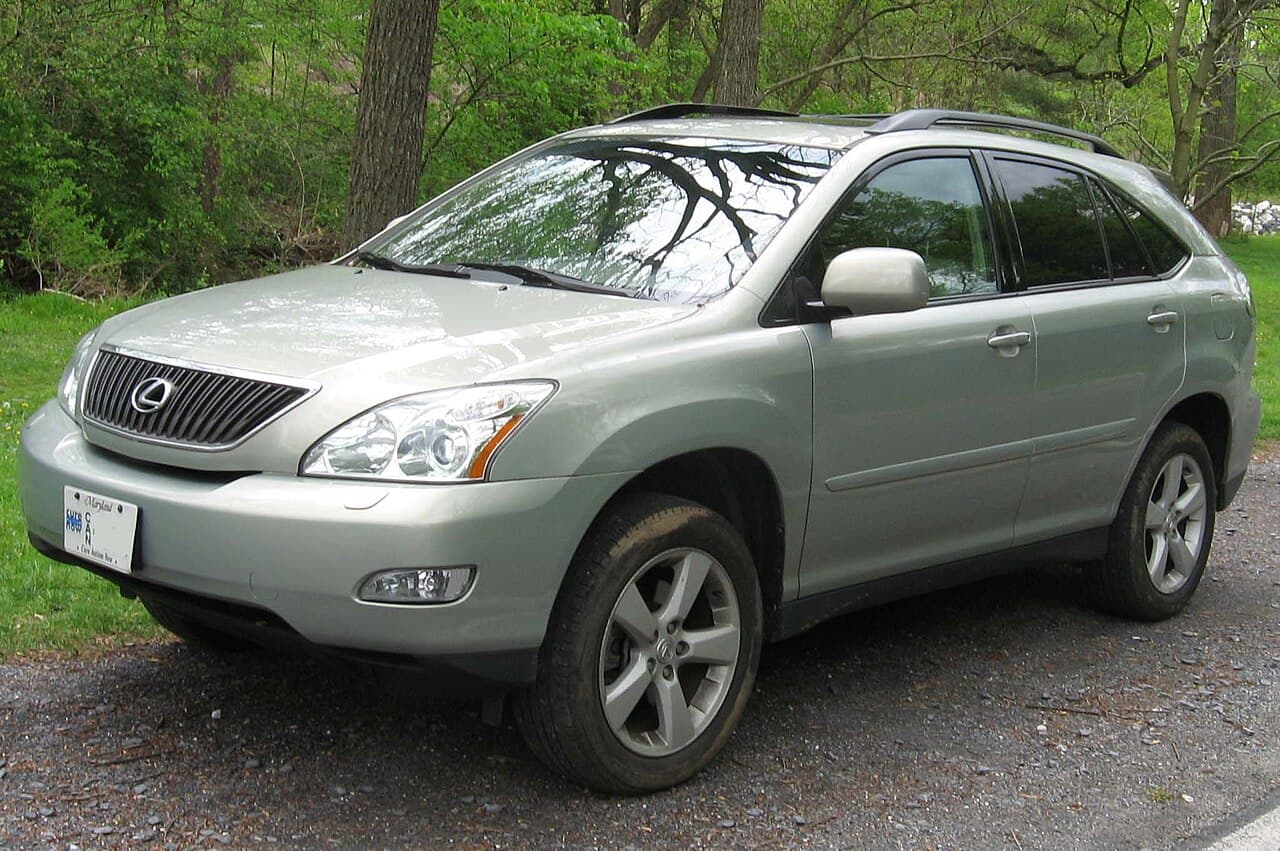
 2003–2009XU30XU303.3 V6 petrolPetrolSee faults & what to checkPhoto: IFCAR via Wikimedia Commons, Public domain.
Lexus1998–2022 Critical issues documented
Lexus RX: common faults & what to check
Thinking about buying a used Lexus RX (1998–2022) in New Zealand? We've documented 21 known faults for this model spanning electrical, suspension, engine, and fluid leaks. Each researched and verified before it's published. The most serious issues here are rated critical. Every one is listed below with its symptoms and repair cost, and each has its own page with where to look and what to ask the seller. Free, no account needed.
Check this exact Lexus RX
- Odometer history
- Money owing
- Reported stolen
- Ownership history
21
Critical
$700–$2,500
8
Which Lexus RX are you looking at?
Petrol
2003–2009XU30XU303.3 V6 petrolPetrolSee faults & what to checkPhoto: IFCAR via Wikimedia Commons, Public domain. 2009–2015AL10AL102.7 petrolPetrolSee faults & what to checkPhoto: OSX via Wikimedia Commons, Public domain.2009–2015AL10AL103.5 V6 petrolPetrolSee faults & what to checkPhoto: OSX via Wikimedia Commons, Public domain.
 2015–2022AL20AL202.0 turbo petrolPetrolSee faults & what to checkKickTyres illustration, not a photograph.2015–2022AL20AL203.5 V6 petrolPetrolSee faults & what to checkKickTyres illustration, not a photograph.
 2022–nowAL30AL302.4 turbo petrolPetrolSee faults & what to checkKickTyres illustration, not a photograph.
Hybrid
2003–2009XU30XU303.3 hybridHybridSee faults & what to checkPhoto: IFCAR via Wikimedia Commons, Public domain.2009–2015AL10AL103.5 hybridHybridSee faults & what to checkPhoto: OSX via Wikimedia Commons, Public domain.2015–2022AL20AL203.5 hybridHybridSee faults & what to checkKickTyres illustration, not a photograph.2022–nowAL30AL302.5 hybridHybridSee faults & what to checkKickTyres illustration, not a photograph.Now narrow it to the engine
2.0 turbo petrol· 2.0 litre petrol, turbocharged2.4L hybrid (T24A-FXS)· 2.4 litre hybrid2.5 hybrid· 2.5 litre hybrid2.7 petrol· 2.7 litre petrol3.0L petrol (1MZ-FE)· 3.0 litre petrol3.3L petrol (3MZ-FE)· 3.3 litre petrol3.5L petrol (2GR-FE)· 3.5 litre petrol3.5L petrol (2GR-FKS)· 3.5 litre petrol3.5L (2GR-FXE)· 3.5 litre
Start your free check on this Lexus RX
Lexus RXEngine not picked yet
Pick the engine above first: the RX came with 9, and without it the report has to show all of their faults. Pick the engine
Can't confirm for this car
Lexus RX
Nothing has been narrowed yet, so nothing below is a claim about a particular car. Pick a year and an engine to see which faults apply.
Tell us the engine, or check the engine code on the car, before relying on this.
matched on no vehicle context
What to look out for
Serious issue
Inspect ball joint boots for cracking or grease leakage.
Front lower control arm ball joint failure
RX AL10 and AL20 front lower control arm ball joints are a documented wear item, typically failing between 100,000–150,000 km but sometimes earlier on NZ vehicles exposed to chip-seal and gravel surfaces. The ball joint is integral to the lower control arm assembly on most variants, requiring full arm replacement. A failed joint causes loss of steering geometry and in extreme cases collapse of the front corner — a safety-critical failure that will cause WOF rejection.
What you would notice
Serious issue
Look at the front of the engine (top, driver's side of the V) for the VVT-i oil line — the updated part is all metal.
2GR-FE VVT-i rubber oil line failure — sudden major oil leak (RX350)
The 3.5 2GR-FE V6 in 2007-2011 RX350s used a VVT-i oil supply line with a short rubber hose section that can split without warning and dump engine oil rapidly — capable of destroying the engine if driven on. Toyota ran a customer support campaign replacing the hose with an all-metal pipe, but coverage has expired and imports may never have had it done. Any 2GR-FE of this era should be confirmed as having the updated metal line.
What you would notice
Serious issue
Ask a hybrid specialist to scan for historical hybrid system codes (P0A78, P3125 etc.) before purchase.
RX400h hybrid inverter failure — sudden loss of drive
The RX400h's power inverter (the electronics that drive the hybrid motors) has a documented failure pattern: transistor failure causes the car to throw hybrid warnings and go into limp mode or lose drive entirely, sometimes affecting power steering and braking assistance. Lexus extended inverter warranty coverage in some markets after complaints and lawsuits, but those programmes have expired; replacement with new parts is very expensive, though good used/reconditioned inverters bring the cost down.
What you would notice
Serious issue
Request documented timing belt service history with workshop receipts.
1MZ-FE and 3MZ-FE Timing Belt Failure
All first and second generation RX (RX300 and RX330) use the 1MZ-FE 3.0L V6 or 3MZ-FE 3.3L V6, both interference engines with rubber timing belts requiring replacement at 100,000 km. Belt failure causes immediate valve-to-piston contact and catastrophic internal engine damage. Water pump failure is a secondary risk as coolant contamination accelerates belt degradation. Most NZ grey imports of this era have no documented belt history, making belt condition and age a critical pre-purchase concern.
What you would notice
Costly issue
Pull the dipstick and note the oil level; ask to see service records showing oil top-up frequency.
2GR-FE Excessive Engine Oil Consumption
The 2GR-FE 3.5L V6 is documented to consume engine oil at rates of 0.5–1.5 litres per 1,000 km on higher-mileage examples, due to a piston ring and oil control rail design that allows oil to pass into the combustion chamber under light throttle and deceleration. Toyota and Lexus acknowledged the issue across multiple 2GR-FE applications and issued technical service bulletins defining acceptable consumption thresholds and piston ring replacement criteria. Left unaddressed, catalytic converter contamination and spark plug fouling follow.
What you would notice
Costly issue
Watch the energy monitor for rapid state-of-charge swings on the test drive.
Hybrid battery ageing on RX400h and RX450h
RX400h (2005-2008) and RX450h (2009-2015) NiMH battery packs typically last 8-15 years in NZ conditions, and most of these cars are now at or beyond that window, so pack degradation and cell failures are increasingly common. The car still drives on a weak pack but economy collapses and the hybrid warning eventually appears. NZ specialists (Infinitev and others) supply reconditioned or new packs with warranty at a fraction of dealer cost.
What you would notice
See all 21 documented issues
Depends on which engine this Lexus RX has — 21
Engine, transmission & cooling
011MZ-FE and 3MZ-FE Timing Belt Failure
Can't confirm for this car
OccasionalEngine $700–$1,600 to fix
Can't confirm for this car
All first and second generation RX (RX300 and RX330) use the 1MZ-FE 3.0L V6 or 3MZ-FE 3.3L V6, both interference engines with rubber timing belts requiring replacement at 100,000 km. Belt failure causes immediate valve-to-piston contact and catastrophic internal engine damage. Water pump failure is a secondary risk as coolant contamination accelerates belt degradation. Most NZ grey imports of this era have no documented belt history, making belt condition and age a critical pre-purchase concern.
Symptoms to notice
What to check
Ask the seller
022GR-FE Excessive Engine Oil Consumption
Can't confirm for this car03T24A-FXS turbo hybrid timing chain early mechanical wear
Can't confirm for this car
OccasionalEngine $3,000–$6,000 to fix
Can't confirm for this car
The T24A-FXS 2.4-litre turbocharged hybrid engine introduced in the RX500h and RX350h (AL30 generation) has been documented with early timing chain mechanical wear on higher-mileage examples and those with delayed or incorrect oil changes. Reports on Lexus and Toyota owner forums describe cold-start chain rattle — a mechanical noise distinct from NVH opinion — that may clear with warm-up or persist. The T24A-FXS is a new platform with a developing fault history, but the pattern mirrors other Toyota turbocharged direct-injection engines known for chain sensitivity to oil condition.
 Example of the part — not this vehicle
The front of a twin-cam engine with the timing cover off — chain, sprockets and guides.
Symptoms to notice
What to check
Ask the seller
04RX 450h Hybrid Inverter Electric Water Pump Failure
Can't confirm for this car
OccasionalCooling $1,100–$3,200 to fix
Can't confirm for this car
The RX 450h uses a dedicated secondary cooling circuit for the hybrid inverter and power electronics, circulated by an electric water pump independent of the engine-driven coolant pump. This electric pump — a sealed unit with an integrated brushless motor — is a documented failure component: the impeller corrodes, the motor windings fail, or the pump seizes, triggering hybrid system faults and forcing the vehicle into a reduced-power or no-start condition. Toyota issued service guidance on this pump across hybrid platforms sharing the 2GR-FXE.
Symptoms to notice
What to check
Ask the seller
05Radiator Plastic End Tank Cracking and Coolant Leak
Can't confirm for this car06Denso fuel pump recall — engine stall risk (RX350/RX450h)
Can't confirm for this car
OccasionalEngine $0–$1,200 to fix
Can't confirm for this car
2016-2022 RX350 and RX450h are included in the global Denso fuel pump recall (NHTSA 20V-012 and matching Australian campaigns): the pump's plastic impeller can swell and seize, stalling the engine without warning at any speed. Replacement is free at Lexus dealers and US owners got a 15-year/150,000-mile pump warranty via class action; NZ/AU buyers should simply verify the campaign is done on the VIN. The fourth-gen RX is otherwise one of the cleanest-record large SUVs of its era.
Symptoms to notice
What to check
Ask the seller
072GR-FE / 2GR-FXE Coolant Hose Deterioration and Bypass Hose Failure
Can't confirm for this car08U660E / U660-E 6-Speed Automatic Torque Converter Shudder
Can't confirm for this car
OccasionalTransmission $250–$5,500 to fix
Can't confirm for this car
The U660E 6-speed automatic transmission fitted to RX 350 models develops a characteristic shudder or vibration during light throttle application at highway cruise speeds, caused by degraded torque converter lock-up clutch friction material contaminating the transmission fluid. Lexus and Toyota issued guidance recommending a specific Toyota WS (World Standard) ATF change as a first corrective step; in advanced cases the torque converter requires replacement. Vehicles with infrequent or incorrect-fluid transmission services are significantly more prone to early onset.
 Example of the part — not this vehicle
A torque converter, sectioned. The lock-up clutch inside is what shudders.
Symptoms to notice
What to check
Ask the seller
Electrical
01RX400h hybrid inverter failure — sudden loss of drive
Can't confirm for this car
OccasionalElectrical $3,000–$6,500 to fix
Can't confirm for this car
The RX400h's power inverter (the electronics that drive the hybrid motors) has a documented failure pattern: transistor failure causes the car to throw hybrid warnings and go into limp mode or lose drive entirely, sometimes affecting power steering and braking assistance. Lexus extended inverter warranty coverage in some markets after complaints and lawsuits, but those programmes have expired; replacement with new parts is very expensive, though good used/reconditioned inverters bring the cost down.
Symptoms to notice
What to check
Ask the seller
02RX 450h High-Voltage Hybrid Battery Cell Degradation
Can't confirm for this car03Hybrid battery ageing on RX400h and RX450h
Can't confirm for this car04Infotainment touchpad/screen freezes and glitches
Can't confirm for this car
OccasionalElectrical $0–$1,500 to fix
Can't confirm for this car
The fourth-gen RX's Remote Touch touchpad interface is widely disliked and the head unit can freeze, reboot or lose phone connectivity, particularly on pre-facelift (2015-2019) cars before CarPlay/Android Auto arrived. Software updates and occasional head unit replacements resolved most cases under warranty. A nuisance rather than a mechanical risk, but head unit hardware out of warranty is expensive, so test it thoroughly.
Symptoms to notice
What to check
Ask the seller
05Power Liftgate Actuator Motor Failure
Can't confirm for this car
Very commonElectrical $400–$1,400 to fix
Can't confirm for this car
The electrically-operated power liftgate on the RX AL10 and AL20 generations uses a pair of electric actuator strut units that combine a gas spring with an integrated electric motor. The motor windings and gear mechanism inside each strut are a well-documented failure point: the gate loses the ability to open or close under power, or partially opens then stops. The struts also progressively lose gas charge, causing the gate to drop under its own weight even when the motor is functional.
Symptoms to notice
What to check
Ask the seller
06Electronic door handle (e-latch) sticking or failing (2023- RX)
Can't confirm for this car
OccasionalElectrical $400–$1,200 to fix
Can't confirm for this car
The fifth-generation RX shares the NX's electronic e-latch exterior door handles, and the same fault pattern: water ingress makes the exterior handle jam solid so the door won't open from outside, worst in cold/wet conditions. Lexus has replaced handles with improved parts under service campaigns overseas on 2023-2024 cars. Check every handle works and whether campaign work is recorded.
Symptoms to notice
What to check
Ask the seller
07Reversing camera blank-screen recall (2023-2025)
Can't confirm for this car
OccasionalElectrical $0–$500 to fix
Can't confirm for this car
The RX is included alongside the NX and TX in Toyota's recall for the reversing camera image failing to display when shifting to reverse under certain conditions. The remedy is a free software update (or camera replacement) at a Lexus dealer. The fifth-gen RX is otherwise too new to have established mechanical fault patterns — recall status and service history are the main checks.
Symptoms to notice
What to check
Ask the seller
Body, brakes, suspension & interior
01Front lower control arm ball joint failure
Can't confirm for this car
CommonSuspension $950–$2,500 to fix
Can't confirm for this car
RX AL10 and AL20 front lower control arm ball joints are a documented wear item, typically failing between 100,000–150,000 km but sometimes earlier on NZ vehicles exposed to chip-seal and gravel surfaces. The ball joint is integral to the lower control arm assembly on most variants, requiring full arm replacement. A failed joint causes loss of steering geometry and in extreme cases collapse of the front corner — a safety-critical failure that will cause WOF rejection.
 Example of the part — not this vehicle
A separated lower ball joint: the control arm has dropped and the wheel has splayed out under the guard.
Symptoms to notice
What to check
Ask the seller
02RX 450h Hybrid Brake Actuator Pump Noise and Failure
Can't confirm for this car
OccasionalBrakes $1,800–$5,500 to fix
Can't confirm for this car
The RX 450h uses an electrohydraulic brake actuator (brake booster pump) to integrate regenerative and friction braking. This actuator pump is known to develop a loud whirring or grinding noise as its internal components wear, and in failure it triggers the ABS, VSC, and brake warning lights simultaneously while reducing braking assistance. The pump is a sealed assembly that cannot be rebuilt and must be replaced as a unit. Failure is more prevalent on vehicles with high mileage or those that have sat unused for extended periods.
Symptoms to notice
What to check
Ask the seller
03Power steering rack leak — passenger-side outer seal (RX330/RX350)
Can't confirm for this car04TEMS Electronic Suspension Actuator Failure
Can't confirm for this car
OccasionalSuspension $400–$1,400 to fix
Can't confirm for this car
RX300 and RX330 variants equipped with the Toyota Electronic Modulated Suspension (TEMS) system suffer failure of the electric actuators that control damper stiffness switching. Actuators corrode internally and seize, locking the suspension in one damper mode. Replacement actuators are no longer available new from Lexus in most markets and must be sourced second-hand or from specialist rebuilders, complicating repair.
Symptoms to notice
What to check
Ask the seller
05Sticky / melting dashboard (heat-degraded soft-touch surface)
Can't confirm for this car
CommonInterior $1,500–$3,500 to fix
Can't confirm for this car
Like other Lexus models of the era, 2007-2012 RX dashboards degrade in strong sun: the surface turns glossy, tacky and eventually gooey, creating bad windscreen glare. Lexus's Warranty Enhancement Program covered replacement dashes in North America but expired years ago, and NZ-new and JDM import cars were generally never covered. A replacement dash is a big, labour-heavy job, so most owners live with it — price accordingly.
Symptoms to notice
What to check
Ask the seller
Lexus RX faults in detail
2GR-FE / 2GR-FXE Coolant Hose Deterioration and Bypass Hose Failure2GR-FE Excessive Engine Oil Consumption2GR-FE VVT-i rubber oil line failure — sudden major oil leak (RX350)Hybrid battery ageing on RX400h and RX450hPower steering rack leak — passenger-side outer seal (RX330/RX350)Radiator Plastic End Tank Cracking and Coolant LeakRX 450h High-Voltage Hybrid Battery Cell Degradation
What these repairs cost on other cars
Some of the Lexus RX’s documented faults are repairs other models share. Each page lists the documented NZ cost for every model it affects.
Other Lexus models
Lexus RX buyer questions
Is the Lexus RX reliable?
Like any used car, it depends on the specific example and its service history. Across the 21 documented faults for the Lexus RX, the recurring problem areas are electrical, suspension, and engine. A Lexus RX with a full service history and no signs of the issues listed on this page can be a sound buy but each one needs to be checked individually before you commit.
What are the most common problems with a used Lexus RX?
We've catalogued 21 known faults for the Lexus RX, covering electrical, suspension, and engine. All 21 are written out in full on this page, with the symptoms to notice, what to inspect, and typical repair costs for each. Free to read, no account needed.
How much do repairs cost on a Lexus RX?
Most single repairs on the Lexus RX fall between $700–$2,500 at NZ independent-workshop rates. Some of the 21 documented faults cost less and a few cost considerably more, and no one car needs them all. Knowing which ones to look for before you view is what lets you negotiate the price down or walk away.
Should I get a pre-purchase inspection on a Lexus RX?
Yes. A Lexus RX inspection focused on its known weak points is the single best way to avoid an expensive mistake. KickTyres gives you a guided, model-specific inspection plus a market valuation and negotiation figure for $24.90 far less than the cost of missing one of the faults on this page.