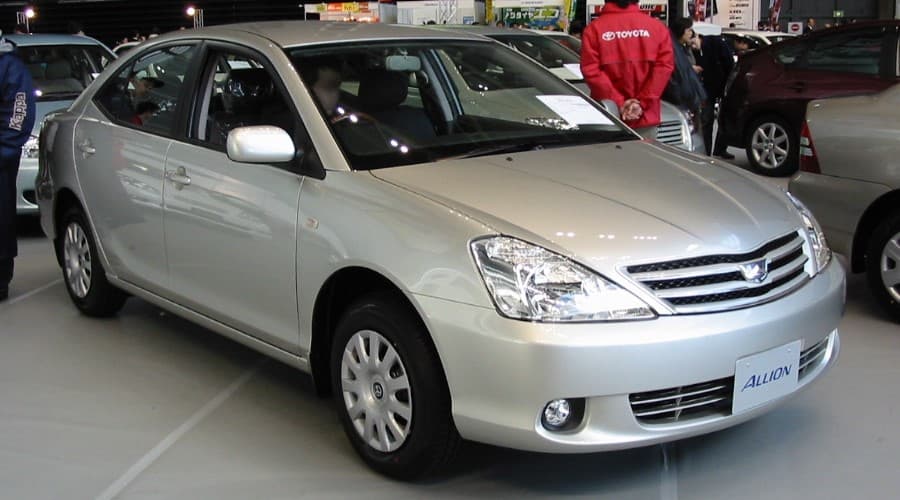
 2001–2007T240T2401.5 petrolPetrolSee faults & what to checkPhoto: Mytho88 via Wikimedia Commons, CC BY-SA 3.0.
Toyota2001–2021 Critical issues documented
Toyota Allion: common faults & what to check
Thinking about buying a used Toyota Allion (2001–2021) in New Zealand? We've documented 13 known faults for this model spanning engine, suspension, transmission, and body & rust. Each researched and verified before it's published. The most serious issues here are rated critical. Every one is listed below with its symptoms and repair cost, and each has its own page with where to look and what to ask the seller. Free, no account needed.
Check this exact Toyota Allion
- Odometer history
- Money owing
- Reported stolen
- Ownership history
13
Critical
$400–$2,500
3
Which Toyota Allion are you looking at?
Petrol
2001–2007T240T2401.5 petrolPetrolSee faults & what to checkPhoto: Mytho88 via Wikimedia Commons, CC BY-SA 3.0.2001–2007T240T2401.8 petrolPetrolSee faults & what to checkPhoto: Mytho88 via Wikimedia Commons, CC BY-SA 3.0.2001–2007T240T2402.0 petrolPetrolSee faults & what to checkPhoto: Mytho88 via Wikimedia Commons, CC BY-SA 3.0. 2007–2021T260T2601.5 petrolPetrolSee faults & what to checkKickTyres illustration, not a photograph.2007–2021T260T2601.8 petrolPetrolSee faults & what to checkKickTyres illustration, not a photograph.2007–2021T260T2602.0 petrolPetrolSee faults & what to checkKickTyres illustration, not a photograph.
Now narrow it to the engine
No engine code is recorded for this option, so faults are matched on capacity and fuel alone. Two engines of the same size cannot be told apart that way, so this list may be wider than your car.
Start your free check on this Toyota Allion
Toyota Allion 1.5 petrol
Likely — same engine family
Toyota Allion · 1.5 petrol
Narrowed by capacity and fuel. No engine code is recorded for this option, so a fault specific to one engine of that size cannot be confirmed from it.
Matched on capacity and fuel, not on an engine code.
- 1 documented fault names an engine this selection cannot confirm. It is listed separately below.
matched on 1.5L engine
What to look out for
Serious issue
Visually inspect the ball joint boot for cracks or grease leakage.
Front Lower Control Arm Ball Joint Failure
The front lower control arm ball joints on both ZZT240 and ZRT260 Allion are a documented wear item that degrades at relatively low mileage on NZ roads. Failed ball joints cause steering vagueness and clunking over bumps. In a severely worn state the joint can separate from the control arm, creating a safety-critical loss of steering control. NZ WOF inspection failures for front ball joint play are commonly reported on imported Allion vehicles.
What you would notice
Costly issue
Inspect each lateral link bush with a bright torch for cracking, splitting, or extrusion of rubber from the metal sleeve.
Rear Suspension Lateral Link Bush Collapse
The rear multi-link suspension on the ZRT260 uses rubber-bonded lateral link bushes to control toe and camber geometry. These bushes harden and crack with age, a process accelerated in vehicles exposed to ozone and UV after importation to New Zealand from the controlled-temperature storage common in Japanese auction yards. Bush collapse allows the rear wheel to move in toe during cornering and braking, which manifests as rear instability and tyre scrub. Complete disintegration of the outer rubber layer results in metal-to-metal contact, producing a loud clunking noise and WoF rejection.
What you would notice
Costly issue
After a 10-minute drive, compare front wheel temperatures by carefully touching each wheel centre — uneven heat indicates a dragging caliper.
Front Brake Caliper Guide Pin Seizure
The front brake calipers on the ZRT260 use sliding guide pins to allow the caliper body to float and apply even pad pressure across both inner and outer brake pads. The guide pins are protected by rubber boots that harden, crack, and allow moisture ingress, after which the pins corrode and seize in their bores. A seized guide pin prevents the caliper from retracting fully after braking, causing the outboard or inboard pad to drag constantly against the rotor. This produces rapid and uneven pad wear, rotor heat damage, and brake pull — all of which are a Warrant of Fitness failure in New Zealand.
What you would notice
Costly issue
Start the test drive from cold if possible.
Super CVT-i (K310/K311) shudder, whine and belt failure from fluid neglect
T260 Allions use Toyota's Super CVT-i belt-and-pulley transmission, which is reliable only if the special CVT fluid is actually changed. Toyota's 100,000 km 'maintenance-free' interval is widely regarded as too long for stop-start use, and most JDM imports arrive in NZ with zero fluid-change history. Neglected units develop shudder off the line, whining, jerky or flaring engagement and eventually belt slip; owner forums document the failure progressing in stages from repairable valve-body/clutch issues to terminal belt damage. A fresh fluid service can save an early case, but a slipping unit needs a replacement transmission — NZ CVT specialists quote roughly $2,600-$3,900 for the unit plus about $900-$1,000 fitting.
What you would notice
Costly issue
Take a torch and phone camera and get down at each corner: photograph the sills, floor pan, rear beam/subframe and suspension mounting points.
Underbody and subframe rust on imports from Japanese snow prefectures
The Allion was never sold new in NZ, so every example is a JDM import, and Japanese-market cars carry no factory underseal because Japan's roads are mostly salt-free — except in snow prefectures, where heavy de-icing salt eats unprotected floors, sills, subframes, brake and fuel lines. Japanese auction grades barely reflect underbody condition, so a tidy-looking Allion can hide serious corrosion that will fail a WoF. Import guides for NZ buyers specifically warn to check sills, wheel arches and the undercarriage before purchase. Surface rust is treatable; perforated sills or crusty subframes mean structural repair bills.
What you would notice
Common issue
Insist on a stone-cold start — put your hand on the bonnet first; if it is warm the seller may have pre-warmed it to hide the rattle.
Cold-start rattle from VVT-i actuator and chain tensioner, worsened by oil neglect (1.5 1NZ-FE)
The 1.5-litre 1NZ-FE used across both Allion generations is famous for a one-to-two-second rattle on cold start. The usual culprits are a worn VVT-i cam gear or a timing-chain tensioner that bleeds down overnight, both aggravated by long oil-change intervals and dirty oil — common in JDM imports with no service history. A brief rattle that disappears immediately is mostly a nuisance; a rattle that lingers, or returns when accelerating, means the tensioner, guides or a stretched chain need attention before the chain skips a tooth. The engine also has small piston oil-return holes that clog with sludge on neglected cars, leading to oil burning at high mileage.
What you would notice
All 7 issues for this one
1 rated criticalEngine, transmission & cooling
01Cold-start rattle from VVT-i actuator and chain tensioner, worsened by oil neglect (1.5 1NZ-FE)
CommonEngine $400–$2,000 to fix
The 1.5-litre 1NZ-FE used across both Allion generations is famous for a one-to-two-second rattle on cold start. The usual culprits are a worn VVT-i cam gear or a timing-chain tensioner that bleeds down overnight, both aggravated by long oil-change intervals and dirty oil — common in JDM imports with no service history. A brief rattle that disappears immediately is mostly a nuisance; a rattle that lingers, or returns when accelerating, means the tensioner, guides or a stretched chain need attention before the chain skips a tooth. The engine also has small piston oil-return holes that clog with sludge on neglected cars, leading to oil burning at high mileage.
 Example of the part — not this vehicle
The front of a twin-cam engine with the timing cover off — chain, sprockets and guides.
Symptoms to notice
What to check
Ask the seller
Body, brakes, suspension & interior1 critical
02Front Lower Control Arm Ball Joint Failure
CommonSuspension $400–$900 to fix
The front lower control arm ball joints on both ZZT240 and ZRT260 Allion are a documented wear item that degrades at relatively low mileage on NZ roads. Failed ball joints cause steering vagueness and clunking over bumps. In a severely worn state the joint can separate from the control arm, creating a safety-critical loss of steering control. NZ WOF inspection failures for front ball joint play are commonly reported on imported Allion vehicles.
 Example of the part — not this vehicle
A separated lower ball joint: the control arm has dropped and the wheel has splayed out under the guard.
Symptoms to notice
What to check
Ask the seller
03Underbody and subframe rust on imports from Japanese snow prefectures
OccasionalBody & Rust $500–$3,000 to fix
The Allion was never sold new in NZ, so every example is a JDM import, and Japanese-market cars carry no factory underseal because Japan's roads are mostly salt-free — except in snow prefectures, where heavy de-icing salt eats unprotected floors, sills, subframes, brake and fuel lines. Japanese auction grades barely reflect underbody condition, so a tidy-looking Allion can hide serious corrosion that will fail a WoF. Import guides for NZ buyers specifically warn to check sills, wheel arches and the undercarriage before purchase. Surface rust is treatable; perforated sills or crusty subframes mean structural repair bills.
Symptoms to notice
What to check
Ask the seller
04Rear Suspension Lateral Link Bush Collapse
05Front Brake Caliper Guide Pin Seizure
CommonBrakes $220–$550 to fix
The front brake calipers on the ZRT260 use sliding guide pins to allow the caliper body to float and apply even pad pressure across both inner and outer brake pads. The guide pins are protected by rubber boots that harden, crack, and allow moisture ingress, after which the pins corrode and seize in their bores. A seized guide pin prevents the caliper from retracting fully after braking, causing the outboard or inboard pad to drag constantly against the rotor. This produces rapid and uneven pad wear, rotor heat damage, and brake pull — all of which are a Warrant of Fitness failure in New Zealand.
Symptoms to notice
What to check
Ask the seller
06Electric Power Steering Rack Rattle and Knock
CommonSuspension $180–$3,200 to fix
The ZRT260 Allion uses a column-assist electric power steering (EPS) system. The steering rack internal yoke spring and yoke pad wear, allowing the rack bar to develop axial play within the housing. This produces a rattle or clunk that is most pronounced at low speeds over sharp bumps or during slow-speed parking manoeuvres. Toyota issued a revised yoke plug design for this rack, but many vehicles in the import fleet have not received the fix. In more advanced cases, the EPS motor control unit can develop intermittent faults producing a momentary loss of power assistance.
Symptoms to notice
What to check
Ask the seller
Only with a certain gearbox: 1 issue
Engine, transmission & cooling
Other Toyota Allion engines and years
Engine, transmission & cooling
01Stripped head-bolt threads in the alloy block causing sudden coolant loss (2.0 1AZ-FSE)
Does not apply
OccasionalEngine $1,800–$5,000 to fix
Does not apply
AZ-series blocks cast before mid-2007 have shallow head-bolt threads at the thinnest rear section of the aluminium block. The threads can strip without warning, letting the head lift, which blows the head gasket and dumps coolant — the same well-documented failure seen on 1AZ/2AZ RAV4, Avensis and Camry. Caught early it is repairable with thread inserts (Time-Sert style); driven on while overheating, the engine is usually scrap. It is an occasional rather than universal failure, but it is catastrophic when it happens, so treat any coolant-loss history on a 2.0 T240 seriously.
Symptoms to notice
What to check
Ask the seller
02Excessive oil consumption from piston ring design (1.8 1ZZ-FE petrol)
Does not apply
Very commonEngine $2,200–$4,500 to fix
Does not apply
The 1.8 litre 1ZZ-FE petrol in the ZZT240 Allion is a known issue for burning oil past its piston rings, a design weakness it shares with the Corolla and Caldina of the same era, and Toyota later revised the pistons. Affected engines use oil between services without obvious leaks, and running low on oil can damage the bearings and the catalytic converter. Check the oil level at the viewing and ask how often it needs topping up.
Symptoms to notice
What to check
Ask the seller
03Excessive oil consumption from clogged piston oil-return holes (1.8 1ZZ-FE)
Does not apply04D-4 direct-injection carbon build-up, EGR clogging and injector/fuel-pump failures (2.0 1AZ-FSE)
Does not apply05Water pump coolant weep and bearing whine (1.8 2ZR-FE)
Does not apply
CommonCooling $350–$750 to fix
Does not apply
The 2ZR-FE 1.8 fitted to later T260 Allions has a well-documented water pump weakness: the internal seal fails and coolant weeps from the pump's tell-tale hole, sometimes with a whining bearing noise. Toyota issued a TSB for the same engine in the 2009-2010 Corolla/Matrix instructing pump replacement for coolant leak or abnormal noise. It rarely fails outright, but a leaking pump slowly empties the cooling system, and an overheated alloy engine is an expensive way to save a few hundred dollars. Replacement is straightforward at any NZ workshop.
Symptoms to notice
What to check
Ask the seller
06Throttle Body Carbon Fouling (1ZR-FAE)
Does not apply
OccasionalEngine $120–$320 to fix
Does not apply
The 1ZR-FAE is a port-injected engine, but its Valvematic variable-lift system and wide-range VVT-i mapping create operating conditions that promote carbon accumulation on the throttle plate and throttle bore walls over time. Extended service intervals or the use of lower-grade oils increases blowby, which deposits oil vapour onto the throttle body via the PCV system. A partially occluded throttle plate causes the ECU to miscalculate mass airflow at low openings, resulting in erratic idle and hesitation off idle — symptoms that can be misdiagnosed as Valvematic or injector faults before the throttle body is inspected.
Symptoms to notice
What to check
Ask the seller
Toyota Allion service schedule
First Generation (T240) · 2001–2007 · 1.5L (1NZ-FE) - Standard base model
Due by distance
- 150,000 km
Check the alternator brushes and the condition of the serpentine belt.
- 200,000 km
Have a specialist assess the suspension bushings and shock absorbers for perishing.
- 250,000 km
Keep an eye on slight oil use, which is normal enough for the 1NZ-FE engine at this point in its life.
Looking at a Toyota Allion for sale?
- Odometer history
- Money owing
- Reported stolen
- Ownership history
Toyota Allion faults in detail
What these repairs cost on other cars
Some of the Toyota Allion’s documented faults are repairs other models share. Each page lists the documented NZ cost for every model it affects.
Other Toyota models
Toyota Allion buyer questions
Is the Toyota Allion reliable?
Like any used car, it depends on the specific example and its service history. Across the 13 documented faults for the Toyota Allion, the recurring problem areas are engine, suspension, and transmission. A Toyota Allion with a full service history and no signs of the issues listed on this page can be a sound buy but each one needs to be checked individually before you commit.
What are the most common problems with a used Toyota Allion?
We've catalogued 13 known faults for the Toyota Allion, covering engine, suspension, and transmission. All 13 are written out in full on this page, with the symptoms to notice, what to inspect, and typical repair costs for each. Free to read, no account needed.
How much do repairs cost on a Toyota Allion?
Most single repairs on the Toyota Allion fall between $400–$2,500 at NZ independent-workshop rates. Some of the 13 documented faults cost less and a few cost considerably more, and no one car needs them all. Knowing which ones to look for before you view is what lets you negotiate the price down or walk away.
Should I get a pre-purchase inspection on a Toyota Allion?
Yes. A Toyota Allion inspection focused on its known weak points is the single best way to avoid an expensive mistake. KickTyres gives you a guided, model-specific inspection plus a market valuation and negotiation figure for $24.90 far less than the cost of missing one of the faults on this page.