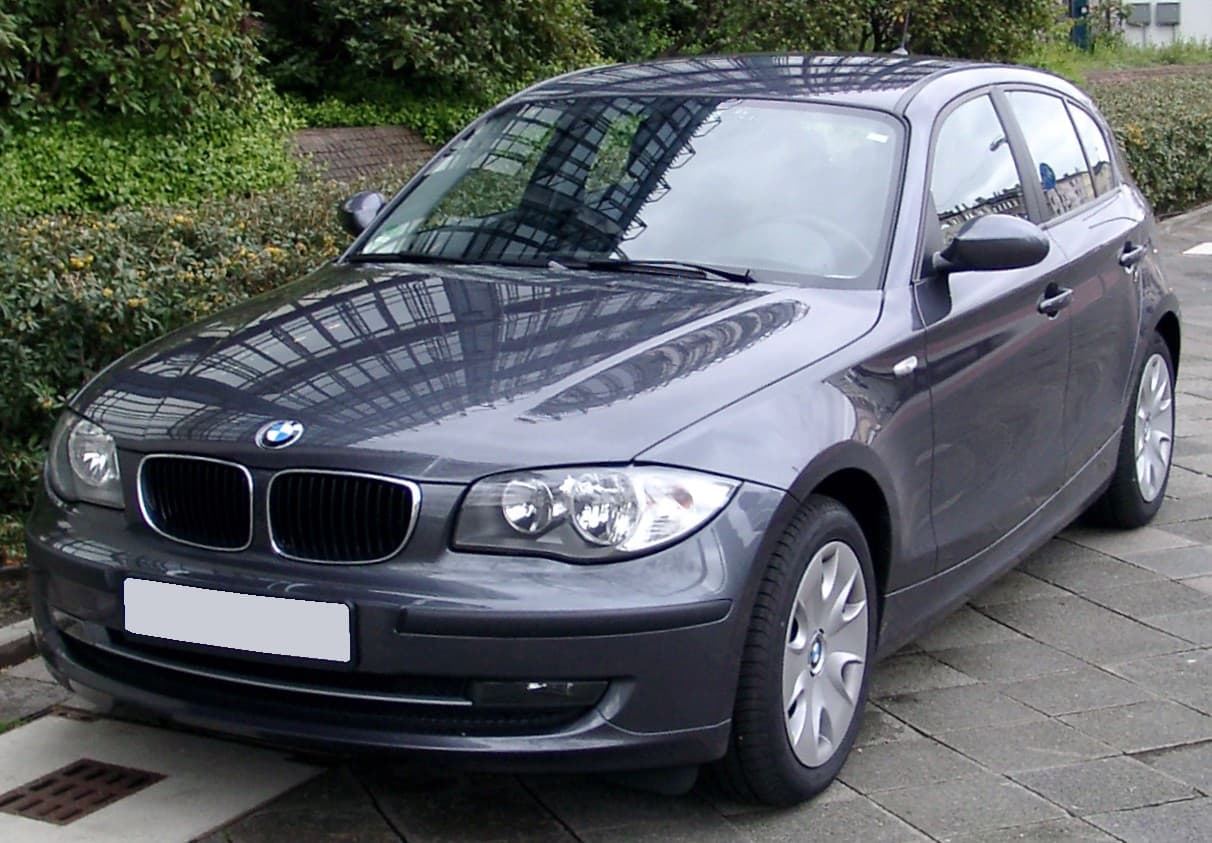
 2004–2014E87 SelectedE872.0 petrolPetrolSee faults & what to checkPhoto: Rudolf Stricker via Wikimedia Commons, CC BY-SA 3.0.
BMW2004–2019 Critical issues documented
BMW 1 Series E87: common faults & what to check
The E87 is the BMW 1 Series built 2004–2014. It was sold here with the 2.0 petrol, 2.0 diesel, and 3.0 petrol (130i). Of the 50 faults documented for the 1 Series, 6 apply to this generation, each with its symptoms, what to inspect and a typical repair cost. Free, no account needed.
Check this exact BMW 1 Series
- Odometer history
- Money owing
- Reported stolen
- Ownership history
50
Critical
$700–$2,500
8
You're looking at the E87
2004–2014E87 SelectedE872.0 petrolPetrolSee faults & what to checkPhoto: Rudolf Stricker via Wikimedia Commons, CC BY-SA 3.0.2004–2014E87 SelectedE872.0 dieselDieselSee faults & what to checkPhoto: Rudolf Stricker via Wikimedia Commons, CC BY-SA 3.0.2004–2014E87 SelectedE873.0 petrol (130i)PetrolSee faults & what to checkPhoto: Rudolf Stricker via Wikimedia Commons, CC BY-SA 3.0.Now narrow it to the engine
A 2004 BMW 1 Series is the E87 generation (2004 to 2014).
Start your free check on this BMW 1 Series
Pick the engine above first: the 1 Series came with 3, and without it the report has to show all of their faults. Pick the engine
Can't confirm for this car
BMW 1 Series · 2004
Narrowed to the year. No engine is recorded for this vehicle. Pick an engine to see which faults apply.
Tell us the engine, or check the engine code on the car, before relying on this.
- No engine is recorded for this vehicle.
matched on year only
What to look out for
Costly issue
Turn lock-to-lock at parking speed and feel for even, light assistance.
Electric power steering column failure (E87)
The E87 uses a column-mounted electric power steering unit that fails with age, suddenly making the steering extremely heavy and logging a steering fault. BMW's fix is a complete column at eye-watering cost; the NZ-realistic repair is a second-hand column or specialist ECU repair. The car remains drivable but heavy, and it fails a WoF if the fault light is on.
What you would notice
Common issue
Rock the car at the front corner with hands on the wheel arch and listen for clunk.
Front Anti-Roll Bar End-Link Premature Wear (E87/E82)
The front anti-roll bar (sway bar) end-links on E87 and E82 chassis use ball-joints that wear out relatively quickly, especially in NZ/AU conditions where roads may be rougher or if the vehicle has been driven with any sporting intent. Failed end-links cause knocking or clunking over road imperfections and speed bumps. This is a high-frequency fault with consistent reports from NZ/AU BMW specialists and is considered a routine consumable on these models. Cost is low but the noise is diagnostic — clunk over bumps that goes away when someone sits on the affected corner is a classic tell.
What you would notice
See all 6 issues for this one
Electrical
01Electric power steering column failure (E87)
OccasionalElectrical $800–$2,500 to fix
The E87 uses a column-mounted electric power steering unit that fails with age, suddenly making the steering extremely heavy and logging a steering fault. BMW's fix is a complete column at eye-watering cost; the NZ-realistic repair is a second-hand column or specialist ECU repair. The car remains drivable but heavy, and it fails a WoF if the fault light is on.
Symptoms to notice
What to check
Ask the seller
Body, brakes, suspension & interior
02Front Anti-Roll Bar End-Link Premature Wear (E87/E82)
Very commonSuspension $200–$600 to fix
The front anti-roll bar (sway bar) end-links on E87 and E82 chassis use ball-joints that wear out relatively quickly, especially in NZ/AU conditions where roads may be rougher or if the vehicle has been driven with any sporting intent. Failed end-links cause knocking or clunking over road imperfections and speed bumps. This is a high-frequency fault with consistent reports from NZ/AU BMW specialists and is considered a routine consumable on these models. Cost is low but the noise is diagnostic — clunk over bumps that goes away when someone sits on the affected corner is a classic tell.
Symptoms to notice
What to check
Ask the seller
Depends on the exact engine — 4 more
Engine, transmission & cooling
01Dual Mass Flywheel (DMF) Wear and Failure
Can't confirm for this car02N46 petrol oil consumption — valve stem seals and crankcase breather (E87)
Can't confirm for this car
CommonEngine $500–$3,500 to fix
Can't confirm for this car
The E87's N45/N46 four-cylinder petrols harden their valve stem seals and clog the crankcase ventilation system, causing blue smoke on start-up and steady oil consumption. The seals can be done in situ but it is a long labour job; the breather/CCV is cheaper. High-km examples also rattle their timing chain tensioners.
Symptoms to notice
What to check
Ask the seller
03N52 3.0 dual-VANOS solenoid sludging and rough idle (130i/125i)
Can't confirm for this car04N45/N46 Valvetronic eccentric shaft sensor and motor failure (E87 116i/118i/120i)
Can't confirm for this carOther BMW 1 Series engines and years
Engine, transmission & cooling
01N47 diesel timing chain failure (rear-mounted, catastrophic)
Does not apply02N47/B47 Diesel Swirl Flap Failure and Inlet Manifold Damage
Does not apply
OccasionalEngine $1,200–$8,500 to fix
Does not apply
The N47 and B47 diesel engines use variable swirl flaps in the intake manifold to improve low-speed combustion efficiency. The flap actuator linkage and flap pivot pins are made of plastic and aluminium and are prone to seizure or fracture. A failed flap can separate and be ingested into the combustion chamber, causing catastrophic piston and valve damage. BMW has issued revised parts with metal construction but the recall/TSB coverage is incomplete across all markets.
Symptoms to notice
What to check
Ask the seller
03N13 1.6 turbo timing chain and VANOS problems (F20 114i/116i/118i)
Does not apply
CommonEngine $1,500–$7,000 to fix
Does not apply
The entry F20 petrols use the N13 (Prince-family) 1.6 turbo, which inherits the stretched timing chain, failing tensioner and VANOS solenoid problems of its Mini/Peugeot relatives. Chain failure destroys the engine; whining or rattling means the chain kit is due. These engines also carbon up their intake valves being direct injection.
 Example of the part — not this vehicle
The front of a twin-cam engine with the timing cover off — chain, sprockets and guides.
Symptoms to notice
What to check
Ask the seller
04N47S 2.0L twin-turbo timing chain and high-output stress (123d / 125d)
Does not apply05N13/N18 timing chain stretch — cam-crank fault
Does not apply06N20 2.0T timing chain guide failure (125i)
Does not apply07N47 2.0D EGR Cooler Gasket Failure & White Smoke
Does not apply08N20 2.0L turbo timing-chain guide failure (125i F20)
Does not apply09N20 2.0T electric water pump failure (125i)
Does not apply10B47 2.0D Timing Chain Tensioner Wear & Cold Rattle
Does not apply11B38A15 Three-Cylinder Oil Consumption and Piston Ring Wear
Does not apply
OccasionalEngine $3,000–$8,000 to fix
Does not apply
The B38A15 1.5L three-cylinder turbocharged petrol engine used in entry-level 116i models has a documented pattern of elevated oil consumption, particularly in higher-mileage examples. Piston ring design on early production units allows oil to pass into the combustion chamber, causing blue smoke on startup and rapid oil level drop. BMW revised piston ring specifications in a later production update but many early-build engines remain on original rings. The small sump capacity (approximately 4.5L) means consumption is noticed quickly.
Symptoms to notice
What to check
Ask the seller
127-speed dual-clutch (Getrag 7DCT300) low-speed judder and clutch-pack wear (F40 116i/118i/120i/116d)
Does not apply13N54 / N55 3.0L twin/single-turbo wastegate rattle & turbo failure (135i E82)
Does not apply14B47 Diesel Timing Chain Cold-Start Rattle (F20/F21 116d/118d/120d)
Does not apply
OccasionalEngine $2,500–$7,000 to fix
Does not apply
The B47 2.0d engine that replaced the N47 in the F20/F21 from around 2014-2015 features a revised front-mounted timing chain intended to address the N47 rear-chain catastrophe. However, documented cases of cold-start timing chain rattle emerged on higher-mileage examples (typically over 120,000 km) and on vehicles with extended oil-change intervals. The rattle is caused by chain tensioner lag on cold start — oil pressure takes time to build, leaving the chain momentarily slack. While far less catastrophic than the N47 failure mode, persistent rattle indicates chain stretch and tensioner wear that will worsen. BMW issued revised tensioner specifications for B47 engines.
Example of the part — not this vehicleThe front of a twin-cam engine with the timing cover off — chain, sprockets and guides.
Symptoms to notice
What to check
Ask the seller
15N47S 2.0L twin-turbo sequential-turbo failure (123d / 125d)
Does not apply16N54 3.0 twin-turbo wastegate rattle and boost faults (135i and 1M)
Does not apply17N43 lean-burn petrol misfire — piezo injector and NOx sensor failure (116i/118i/120i)
Does not apply18N54 Direct Injection Fuel Injector Failure
Does not apply19B48 2.0T Electric Water Pump Failure
Does not apply20N47/B47 Diesel Particulate Filter (DPF) Blockage and Damage
Does not apply21N54 3.0L fuel injector failure & intake-valve carbon build-up (135i E82)
Does not apply
CommonEngine $1,500–$3,500 to fix
Does not apply
The twin-turbo 135i shares the N54's two classic driveability faults. The piezo direct injectors crack or lose calibration, causing misfires, rough idle and hard starting (covered by a since-expired recall/warranty on 2007-2008 builds). Separately, because it is direct-injection, carbon cakes on the intake valves and needs periodic walnut blasting to restore smooth running. Together they make a neglected 135i feel lumpy and misfire-prone.
 Example of the part — not this vehicle
A common-rail diesel injector. Contamination damages the nozzle at the tip.
Symptoms to notice
What to check
Ask the seller
22N54 High Pressure Fuel Pump (HPFP) Failure
Does not apply23ZF 8HP Harsh Kickdown & EGS Software Fault
Does not apply24B58 valve cover PCV diaphragm failure and valve cover gasket leak (M140i)
Does not apply25B47 2.0d AdBlue dosing pump failure
Does not apply
OccasionalEngine $850–$2,200 to fix
Does not apply
The B47D20 diesel engine (which replaced the N47 from 2014 in most markets) uses a Selective Catalytic Reduction (SCR) system to meet Euro 6 / NZ-equivalent emissions standards. The AdBlue (urea solution) dosing pump is a high-precision solenoid-controlled unit that injects a fine mist of AdBlue into the exhaust stream ahead of the SCR catalyst. The pump's internal solenoid valve and nozzle tip are sensitive to AdBlue crystallisation — when the tank is run low repeatedly, concentrated urea solution dries on the nozzle orifice (0.2 mm diameter), blocking flow. Additionally, the pump motor brushes and solenoid windings degrade from the corrosive urea environment if the pump sits dormant. Failure causes the SCR system to stop dosing, triggering an emissions fault that progressively limits engine speed, then locks the car to 40 km/h after a set number of restart cycles.
Symptoms to notice
What to check
Ask the seller
26N13 1.6T VANOS Oil Control Valve Sticking
Does not apply27B47 Diesel EGR Bypass Pipe Cracking and Coolant Loss
Does not apply28B58 coolant loss from plastic hoses, expansion tank and thermostat seals (M140i)
Does not apply29B38 1.5T Three-Cylinder Engine Mount Vibration and Failure (F20 116i/118i)
Does not apply30N55 3.0T charge pipe clamp failure / boost leak
Does not apply31N55 3.0 turbo VANOS housing bolts loosen or break, stall risk (135i, recall 14V-176)
Does not apply
OccasionalEngine $0–$900 to fix
Does not apply
On the N55 3.0 turbo six fitted to the 135i from 2010, the aluminium bolts that hold the two VANOS (camshaft timing) unit housings can loosen over time and may break. If that happens the engine can lose power or stall while driving. BMW recalled these cars in the United States in 2014 (recall 14V-176) to fit new bolts free of charge; we could not confirm an equivalent NZ or Australian campaign, so check with a BMW dealer by VIN whether the bolts have been replaced.
Symptoms to notice
What to check
Ask the seller
32N55 / B58 3.0L turbo wastegate rattle & oil filter housing leak (M135i / M140i F20/F21)
Does not apply
CommonEngine $800–$1,900 to fix
Does not apply
The hot-hatch M135i (N55, 2012-2016) and M140i (B58, 2016-2019) use the turbo 3.0L six. The N55 M135i develops wastegate rattle on cold start (a monitored nuisance). The B58 M140i is very robust but leaks oil/coolant from the oil filter housing gasket and adjacent brittle plastic coolant hose with age. Both are strong engines; these are the genuine items to check rather than any structural flaw.
Symptoms to notice
What to check
Ask the seller
337-speed dual-clutch low-speed hesitation (F40 118i)
Does not apply
OccasionalTransmission $0–$1,500 to fix
Does not apply
The front-drive F40 118i pairs the B38 three-cylinder with a Getrag 7-speed dual-clutch that owners report as jerky and hesitant at parking speeds, with occasional harsh downshift clunks. Software updates have smoothed most cars and mechanical failures are rare, but an unloved example can feel broken to a first-time DCT driver. Overall the F40 has a comparatively clean record.
Symptoms to notice
What to check
Ask the seller
34B58 plastic charge pipe crack or coupler blow-off, sudden boost loss (M140i)
Does not apply
OccasionalEngine $450–$1,100 to fix
Does not apply
The first-generation B58 feeds boosted air from the turbo to the throttle through an all-plastic factory charge pipe. With age and heat the plastic and its coupler become brittle, and the pipe can crack or pop off under boost, giving a sudden loud whoosh, a big loss of power and limp mode. It is far less common than on the older N55, but the risk climbs steeply on tuned cars running extra boost, and the M140i is a very commonly tuned car. Many owners fit an aluminium aftermarket pipe; on its own that is a sign of modification worth asking about.
Symptoms to notice
What to check
Ask the seller
Electrical
01EPS rack motor brush wear causing loss of steering assist
Does not apply
OccasionalElectrical $2,200–$5,500 to fix
Does not apply
The F20 uses a column-assist electric power steering system (ZF Lenksysteme) in which a brushed DC motor on the steering rack provides all steering assistance. Unlike hydraulic systems, the brushes inside the DC motor wear progressively and generate conductive carbon dust that deposits on the commutator segments. This causes intermittent arcing, rising electrical resistance and eventual loss of consistent current to the motor windings. The driver experiences sudden and random loss of power steering assist, typically at low speed or during parking manoeuvres. The fault is most prevalent in high-mileage city cars (above 100,000 km) and worsens in hot climates where motor temperatures are elevated. Replacement requires the full EPS rack unit as the motor is not sold separately by BMW in most markets.
Symptoms to notice
What to check
Ask the seller
02Battery positive cable connector failure recall, car can cut out or not start (E87/E81/E82/E88 1 Series, 2007-2011)
Does not apply
OccasionalElectrical $0–$500 to fix
Does not apply
The E87/E81/E82/E88 1 Series (all engines, 2007-2011) was recalled because the plug-in connection on the main battery positive cable at the fuse box can be damaged by vibration and lose contact. When it fails the car may not unlock or start, and in the later recall wording it can lose power or shut down while driving. BMW Australia recalled these cars twice (PRA 2013/13476, then recall 00 61 7704 00), and the same defect was a 516,791 vehicle recall in the US (NHTSA 13V-044). The fix is free at a BMW dealer if it has not been done.
Symptoms to notice
What to check
Ask the seller
03iDrive/instrument cluster software glitches and 12V battery drain (F40)
Does not apply
OccasionalElectrical $0–$600 to fix
Does not apply
Early F40s log complaints of frozen iDrive screens, dropped wireless CarPlay, phantom warning messages and modules that fail to sleep, draining the 12V battery on cars used for short trips. Nearly all are fixed by dealer software updates; hardware failures are uncommon. Worth checking because an unregistered replacement battery also causes drain symptoms.
Symptoms to notice
What to check
Ask the seller
Body, brakes, suspension & interior
01N20 2.0T brake vacuum pump oil starvation, loss of brake assist recall (125i)
Does not apply
RareBrakes $0–$1,500 to fix
Does not apply
On the 2.0 litre N20 turbo petrol in early F20 125i cars, a seal disc inside the hollow camshaft can shift and block the oil holes that lubricate the brake vacuum pump. The pump can then wear and fail, so the brake pedal suddenly becomes very hard and the car needs much more pedal effort to stop, although the brakes still work. BMW Australia recalled F20 1 Series and other N20 models sold between November 2012 and July 2013 (recall REC-000117) and fitted a locking ring to hold the disc in place. Recall work is free at a BMW dealer.
Symptoms to notice
What to check
Ask the seller
02Takata driver airbag inflator recall PRA 2018/17191 (F20/F21 1 Series, 2014-2017)
Does not apply
OccasionalInterior $0–$1,500 to fix
Does not apply
Some 2014 to 2017 F20/F21 1 Series cars (all engines) were built with a Takata driver's airbag whose propellant can absorb moisture over time. In a crash the inflator can over-pressurise and rupture, throwing metal fragments at the driver, which can cause serious injury or death. BMW Australia recalled F Series cars in a staged campaign from December 2018 (PRA 2018/17191) to replace the airbag free of charge, and a separate 2024 recall (REC-006035) covers cars later fitted with a steering wheel that has a Takata inflator. Have the VIN checked to confirm the recall work is done. Not every car is in the recall; a dealer check of the VIN is the only way to know.
Symptoms to notice
What to check
Ask the seller
Fluid leaks
01N13 1.6T valve cover gasket oil leak onto exhaust
Does not apply02B58 oil filter housing gasket leak, oil and coolant (M140i)
Does not apply03N52 3.0 plastic valve cover and PCV oil leak (130i/125i)
Does not apply04N20 2.0T oil filter housing gasket leak (125i)
Does not apply05Rocker cover and oil filter housing gasket leaks (F20)
Does not apply
Very commonFluid Leaks $400–$1,200 to fix
Does not apply
F20 petrol and diesel engines commonly weep oil from the rocker (valve) cover gasket and oil filter housing gasket from around 80,000 km. Slow leaks drip onto the exhaust or belt drive — a burning smell and, if ignored on the diesel, oil-contaminated engine mounts and belts. Routine but labour-heavy jobs at NZ workshop rates.
Symptoms to notice
What to check
Ask the seller
BMW 1 Series faults in detail
What these repairs cost on other cars
Some of the BMW 1 Series’s documented faults are repairs other models share. Each page lists the documented NZ cost for every model it affects.
Other BMW models
BMW 1 Series buyer questions
Is the BMW 1 Series reliable?
Like any used car, it depends on the specific example and its service history. Across the 50 documented faults for the BMW 1 Series, the recurring problem areas are engine, cooling, and brakes. A BMW 1 Series with a full service history and no signs of the issues listed on this page can be a sound buy but each one needs to be checked individually before you commit.
What are the most common problems with a used BMW 1 Series?
We've catalogued 50 known faults for the BMW 1 Series, covering engine, cooling, and brakes. All 50 are written out in full on this page, with the symptoms to notice, what to inspect, and typical repair costs for each. Free to read, no account needed.
How much do repairs cost on a BMW 1 Series?
Most single repairs on the BMW 1 Series fall between $700–$2,500 at NZ independent-workshop rates. Some of the 50 documented faults cost less and a few cost considerably more, and no one car needs them all. Knowing which ones to look for before you view is what lets you negotiate the price down or walk away.
Should I get a pre-purchase inspection on a BMW 1 Series?
Yes. A BMW 1 Series inspection focused on its known weak points is the single best way to avoid an expensive mistake. KickTyres gives you a guided, model-specific inspection plus a market valuation and negotiation figure for $24.90 far less than the cost of missing one of the faults on this page.