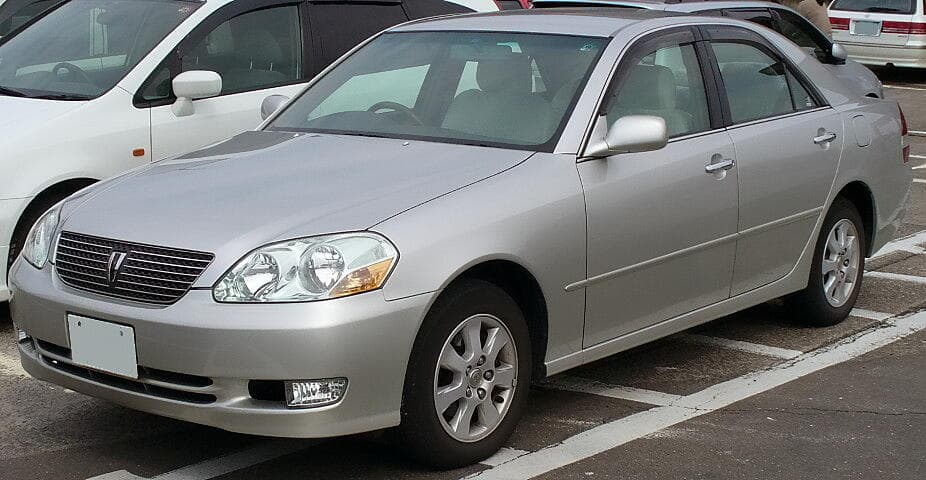
 2000–2008JZX110 SelectedJZX1102.5 turbo petrolPetrolSee faults & what to checkPhoto: Kuha455405 via Wikimedia Commons, CC BY-SA 3.0.
Toyota1992–2007 Critical issues documented
Toyota Mark II: common faults & what to check
Thinking about buying a used Toyota Mark II (1992–2007) in New Zealand? We've documented 22 known faults for this model spanning engine, suspension, transmission, and body & rust. Each researched and verified before it's published. The most serious issues here are rated critical. Every one is listed below with its symptoms and repair cost, and each has its own page with where to look and what to ask the seller. Free, no account needed.
Check this exact Toyota Mark II
- Odometer history
- Money owing
- Reported stolen
- Ownership history
22
Critical
$450–$2,000
17
You're looking at the JZX110 · 2.5 turbo petrol
2000–2008JZX110 SelectedJZX1102.5 turbo petrolPetrolSee faults & what to checkPhoto: Kuha455405 via Wikimedia Commons, CC BY-SA 3.0.Now narrow it to the engine
A 2002 Toyota Mark II is the JZX110 generation (2000 to 2008).
No engine code is recorded for this option, so faults are matched on capacity and fuel alone. Two engines of the same size cannot be told apart that way, so this list may be wider than your car.
Start your free check on this Toyota Mark II
Toyota Mark II JZX110 2.5 turbo petrol
Likely — same engine family
Toyota Mark II · 2002 · 2.5 turbo petrol
Narrowed by capacity and fuel. No engine code is recorded for this option, so a fault specific to one engine of that size cannot be confirmed from it.
Matched on capacity and fuel, not on an engine code.
- 4 documented faults name an engine this selection cannot confirm. They are listed separately below.
matched on 2.5L engine
What to look out for
Serious issue
Spin the tensioner and idler pulleys by hand — any roughness, grinding, or play indicates bearing wear.
Timing Belt Tensioner Pulley Bearing Collapse
The 1JZ-GTE and 2JZ-GE engines fitted to JZX100 and JZX110 Mark II models use a rubber timing belt driven by a spring-loaded hydraulic tensioner and a fixed idler pulley. The tensioner pulley bearing and idler pulley bearing are known to fatigue and collapse — particularly on vehicles where the original belt has not been replaced at the Toyota-specified 100,000 km interval. Bearing collapse causes the belt to skip teeth or jump off entirely, resulting in catastrophic piston-to-valve contact on the interference-design engine. Imported JZX100 examples often arrive in New Zealand at 100,000–180,000 km with no evidence of belt service history.
What you would notice
Costly issue
On a hoist, lever-test each rear arm bush (camber, toe/traction and lower arms) for play and check for split or perished rubber.
Collapsed rear suspension arm bushes and cracked/rusted rear subframe mounts
The X110 rides on a multi-link RWD rear end with soft rubber bushes in the camber, toe/traction and lower arms. After two decades, and especially on cars that were drifted, those bushes perish and the rear subframe mounts can crack, rust or crush at the seams, giving vague handling, uneven tyre wear and clunks. Seized alignment eccentrics are common and add to the repair. Age- and abuse-driven rather than mileage-limited.
What you would notice
Costly issue
Grip the lower arm and attempt to move it fore and aft by hand to feel for pivot play.
JZX110 front lower arm inner bush failure steering shimmy
The front lower control arm inner pivot bushes on the JZX110 are pressed rubber items that deteriorate with age, UV exposure, and the high fore-aft scrub forces generated by the rear-wheel-drive sport sedan platform. Bush failure causes the control arm pivot to develop play, resulting in steering shimmy under braking, tramlining on grooved road surfaces, and accelerated tyre wear. The degradation is progressive and often reaches a significant level of wear before the owner notices handling changes.
What you would notice
Costly issue
Check fluid level via fill plug.
Rear Differential Output Shaft and Pinion Oil Seal Leak
JZX100 and JZX110 Mark II models commonly develop oil seepage at the rear differential output shaft seals and pinion seal. NZ-import examples often show dried oil residue around the diff housing from decades of neglected seal maintenance. Minor seepage left unattended leads to low fluid, premature bearing wear, and eventual gear howl.
What you would notice
Common issue
Turn wheel to full lock in both directions and observe for active weeping.
Power Steering Rack Inner Seal Leak
The hydraulic power steering rack on JZX-platform Mark II develops inner tie rod seal and rack end seal weeping with age, particularly on high-mileage imports. Fluid loss leads to heavier steering and pump whine as the reservoir runs low. Rack reseal or replacement is the only lasting fix; power steering fluid top-ups are a temporary measure that many sellers rely on before sale.
What you would notice
All 10 issues for this one
2 rated criticalEngine, transmission & cooling1 critical
Body, brakes, suspension & interior
Fluid leaks
05Rear Differential Output Shaft and Pinion Oil Seal Leak
CommonFluid Leaks $250–$650 to fix
JZX100 and JZX110 Mark II models commonly develop oil seepage at the rear differential output shaft seals and pinion seal. NZ-import examples often show dried oil residue around the diff housing from decades of neglected seal maintenance. Minor seepage left unattended leads to low fluid, premature bearing wear, and eventual gear howl.
Symptoms to notice
What to check
Ask the seller
06Power Steering Rack Inner Seal Leak
CommonFluid Leaks $400–$1,100 to fix
The hydraulic power steering rack on JZX-platform Mark II develops inner tie rod seal and rack end seal weeping with age, particularly on high-mileage imports. Fluid loss leads to heavier steering and pump whine as the reservoir runs low. Rack reseal or replacement is the only lasting fix; power steering fluid top-ups are a temporary measure that many sellers rely on before sale.
Symptoms to notice
What to check
Ask the seller
Depends on the exact engine or version: 4 issues
Engine, transmission & cooling
011JZ-GTE Timing Belt Failure and Turbo Oil Feed Seal Leak
Can't confirm for this car
CommonEngine $900–$2,800 to fix
Can't confirm for this car
The 1JZ-GTE is an interference engine; belt failure causes piston-to-valve contact and catastrophic engine damage. The turbo oil return line O-ring and banjo bolt seals degrade with age and heat cycles, causing oil to pool in the turbo housing and burn at startup. Both faults are age-related and the majority of NZ-import JZX90/100 examples have no documented belt replacement history.
Symptoms to notice
What to check
Ask the seller
021JZ-GTE turbo oil smoke and abuse/modification history on the turbo cars
Can't confirm for this car031JZ-GE timing chain tensioner wear cold start rattle
Can't confirm for this car041JZ-GE VVTi actuator failure P0011 cam timing fault
Can't confirm for this carOther Toyota Mark II engines and years
Engine, transmission & cooling
011JZ-GE Timing Belt Failure on Neglected Examples
Does not apply02A341E/A340E solenoid wear & clutch pack slip
Does not apply03Automatic Transmission Torque Converter Lock-Up Shudder
Does not apply04JZX90 Head Gasket Seepage on High-Mileage Engines
Does not apply
OccasionalEngine $1,300–$2,800 to fix
Does not apply
JZX90 Mark II 1JZ-GE engines with odometer readings above 180,000 km — common on examples that have been re-complied in New Zealand after accumulated Japanese mileage — exhibit coolant seepage past the head gasket, particularly at the front and rear corners of the cylinder head. The failure typically begins as slow weeping rather than catastrophic breach, making it easy to miss at a casual inspection. Improper past overheats from cooling system neglect accelerate head gasket deterioration.
 Example of the part — not this vehicle
A used multi-layer head gasket. Discolouration between a cylinder and a water gallery is the tell.
Symptoms to notice
What to check
Ask the seller
051JZ-GTE Turbo Oil Return Line Cracking and Oil Burning
Does not apply061JZ-GTE intercooler pipe hose clamp boost leak
Does not applyBody, brakes, suspension & interior
01Front Lower Control Arm Ball Joint Wear
Does not apply
Very commonSuspension $280–$650 to fix
Does not apply
The front lower control arm ball joints on JZX90 and JZX100 Mark II are a standard wear item that sees accelerated deterioration on New Zealand roads due to pot-hole stress and the age of imported examples. The ball joint boot splits with age, allowing grease to escape and water and grit to enter the joint. Once contaminated, the joint wears rapidly. At sufficient wear, the ball joint can separate entirely, causing sudden and complete loss of steering control — this is the single most common reason for WOF failure on these chassis in New Zealand.
 Example of the part — not this vehicle
A separated lower ball joint: the control arm has dropped and the wheel has splayed out under the guard.
Symptoms to notice
What to check
Ask the seller
02Rear Chassis Stress Cracking at Coilover Conversion Mount Points
Does not apply
OccasionalSuspension $600–$2,500 to fix
Does not apply
The JZX90 and JZX100 Mark II are popular drift and performance platforms in New Zealand, and a high proportion of imported examples have been fitted with aftermarket coilover suspension kits. The factory rear upper shock mounting points in the boot floor and wheel well area were engineered for the original suspension loads and geometry. Poorly fitted top hats, incorrect spring rates, or extended hard use concentrate stress on the thin sheet metal around these mounts, causing cracking that can propagate into structural chassis rails. This fault is frequently concealed under boot liner or underbody coating at the time of sale.
Symptoms to notice
What to check
Ask the seller
03JZX90 rear multi-link lower arm bush deterioration
Does not apply04TEMS Suspension Actuator Failure and Ride Height Error
Does not apply
CommonSuspension $400–$2,800 to fix
Does not apply
The JZX100 Mark II Tourer V is fitted with Toyota Electronically Modulated Suspension (TEMS), which uses electric actuators at each corner to switch damper firmness between Sport and Normal modes. The actuator motor assemblies are prone to internal motor failure and seized rotary valves after more than 15–20 years of service. A failed actuator causes that corner to default to its hard stop damping mode, resulting in noticeably uneven ride quality — one corner feeling significantly firmer than the others. The TEMS warning light illuminates and the system cannot complete its self-test, and replacement OEM actuators are scarce, often requiring second-hand units or conversion to non-TEMS aftermarket coilovers.
Symptoms to notice
What to check
Ask the seller
Fluid leaks
011JZ-GTE turbo oil return banjo bolt crush washer leak
Does not apply02Power Steering Pump Seal and Hose Leak
Does not apply
CommonFluid Leaks $220–$950 to fix
Does not apply
The rack-and-pinion power steering system on JZX90 and JZX100 Mark II models uses an engine-driven vane pump with rubber shaft seals and high-pressure hose connections that deteriorate with age and heat cycling. Seals harden and crack after 25–30 years, allowing power steering fluid to weep from the pump body, the high-pressure hose banjo fitting, or the return line. Fluid loss is typically slow, but if left unattended the reservoir empties and the pump runs dry, causing rapid bearing and vane wear.
Symptoms to notice
What to check
Ask the seller
A 2002 Toyota Mark II: what is due, and when
Servicing
Nothing left on the schedule
Placed by the car’s age, not read from the dash — 165,600–386,400 km after 24 years.
Cambelt
Due every 100,000 km, and usually on a time limit as well, whichever comes first. Ask for the invoice rather than the answer: it should show the date, the reading at the time, and whether the water pump went in with it.
Behind it
- 100,000 kmThe first major timing belt service should already be done by here, with the water pump and tensioner replaced at the same time.
- 150,000 kmCheck the turbocharger's oil feed lines and the state of the cooling system parts.
- 200,000 kmSuspension bushings and ball joints can start wearing here, which takes the crispness out of the handling.
“Behind it” means the car has driven past that distance, not that the work was done — ask to see the receipts. These are the intervals for the Ninth Generation (X110) · 2.5L (1JZ-GTE) - 2.5 iR-V Turbo · Petrol; only the car’s own service book says what has actually been done to it.
Looking at a Toyota Mark II for sale?
- Odometer history
- Money owing
- Reported stolen
- Ownership history
Toyota Mark II faults in detail
1JZ-GE timing chain tensioner wear cold start rattle1JZ-GE VVTi actuator failure P0011 cam timing fault1JZ-GTE turbo oil smoke and abuse/modification history on the turbo carsCollapsed rear suspension arm bushes and cracked/rusted rear subframe mountsJZX110 front lower arm inner bush failure steering shimmyStructural rust in sills, rear arches, floor pans and rear subframe mountsTiming Belt Tensioner Pulley Bearing Collapse
What these repairs cost on other cars
Some of the Toyota Mark II’s documented faults are repairs other models share. Each page lists the documented NZ cost for every model it affects.
Other Toyota models
Toyota Mark II buyer questions
Is the Toyota Mark II reliable?
Like any used car, it depends on the specific example and its service history. Across the 22 documented faults for the Toyota Mark II, the recurring problem areas are engine, suspension, and transmission. A Toyota Mark II with a full service history and no signs of the issues listed on this page can be a sound buy but each one needs to be checked individually before you commit.
What are the most common problems with a used Toyota Mark II?
We've catalogued 22 known faults for the Toyota Mark II, covering engine, suspension, and transmission. All 22 are written out in full on this page, with the symptoms to notice, what to inspect, and typical repair costs for each. Free to read, no account needed.
How much do repairs cost on a Toyota Mark II?
Most single repairs on the Toyota Mark II fall between $450–$2,000 at NZ independent-workshop rates. Some of the 22 documented faults cost less and a few cost considerably more, and no one car needs them all. Knowing which ones to look for before you view is what lets you negotiate the price down or walk away.
Should I get a pre-purchase inspection on a Toyota Mark II?
Yes. A Toyota Mark II inspection focused on its known weak points is the single best way to avoid an expensive mistake. KickTyres gives you a guided, model-specific inspection plus a market valuation and negotiation figure for $24.90 far less than the cost of missing one of the faults on this page.