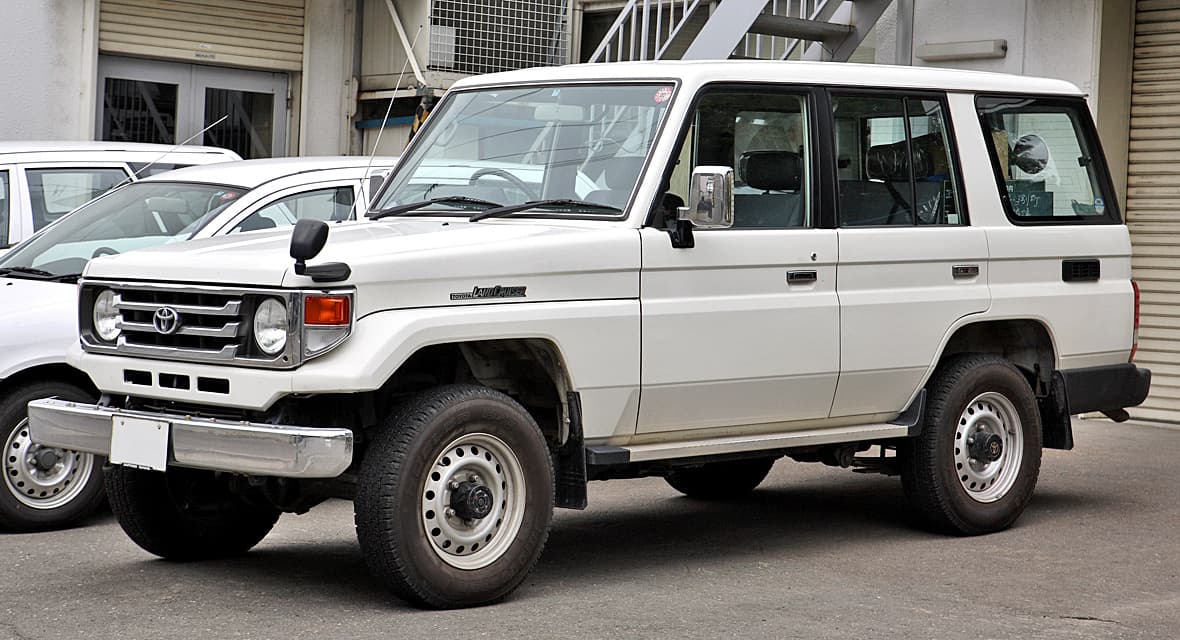
 1984–1999J70 SelectedJ70Engine not documented for this generationEngine not documentedSee faults & what to checkPhoto: Tennen-Gas via Wikimedia Commons, CC BY-SA 3.0.
Toyota1990–2024 Critical issues documented
Toyota Land Cruiser 70: common faults & what to check
Thinking about buying a used Toyota Land Cruiser 70 (1990–2024) in New Zealand? We've documented 20 known faults for this model spanning engine, body & rust, suspension, and transmission. Each researched and verified before it's published. The most serious issues here are rated critical. Every one is listed below with its symptoms and repair cost, and each has its own page with where to look and what to ask the seller. Free, no account needed.
Check this exact Toyota Land Cruiser 70
- Odometer history
- Money owing
- Reported stolen
- Ownership history
20
Critical
$700–$4,500
8
You're looking at the J70
1984–1999J70 SelectedJ70Engine not documented for this generationEngine not documentedSee faults & what to checkPhoto: Tennen-Gas via Wikimedia Commons, CC BY-SA 3.0.Now narrow it to the engine
A 1984 Toyota Land Cruiser 70 is the J70 generation (1984 to 1999).
We cannot narrow the engine list to this year, so every engine this model was sold with is offered.
No engine code is recorded for this option, so faults are matched on capacity and fuel alone. Two engines of the same size cannot be told apart that way, so this list may be wider than your car.
Start your free check on this Toyota Land Cruiser 70
Toyota Land Cruiser 70 J70 2.8 turbo-diesel
Likely — same engine family
Toyota Land Cruiser 70 · 1984 · 2.8 turbo-diesel
Narrowed by capacity and fuel. No engine code is recorded for this option, so a fault specific to one engine of that size cannot be confirmed from it.
Matched on capacity and fuel, not on an engine code.
matched on 2.8L engine
What to look out for
We have not documented any faults for the exact Toyota Land Cruiser 70 you picked.
All 0 issues for this one
Other Toyota Land Cruiser 70 engines and years
Engine, transmission & cooling
011VD-FTV V8 injector failure leading to melted/cracked pistons
Does not apply021VD-FTV Timing Chain Elongation & Stretch
Does not apply03Airbox lid seal lets dust past the filter on the 4.5 V8 (1VD-FTV) — 'dusting'
Does not apply04Diesel particulate filter blocking on September-2016-onward V8 (1VD-FTV)
Does not apply05DPF blocking, failed regens and grass-fire recall on DPF-equipped V8s
Does not apply06Manual gearbox crunching into 2nd and 3rd, worn synchros (4.5 1VD-FTV V8 five-speed manual)
Does not apply071VD-FTV Variable Geometry Turbo Actuator Failure
Does not apply08V8 clutch shudder and premature clutch wear; short 5th gear on pre-2017 trucks
Does not apply091HZ Timing Chain Tensioner Wear at High Mileage
Does not apply
OccasionalEngine $1,200–$3,200 to fix
Does not apply
The 1HZ 4.2L inline-six naturally aspirated diesel (and its turbo variant the 1HD-T) uses a single row timing chain with a hydraulic tensioner that relies on oil pressure and a spring-loaded mechanism to maintain chain tension. At high mileage, typically above 250,000 km with neglected or extended oil change intervals, the tensioner's hydraulic element loses its ability to maintain adequate pressure, and the chain can develop slack. This produces a cold-start rattle very similar in character to the 1VD-FTV chain noise: a metallic clattering from the front of the engine that fades once oil pressure is established. Unlike the 1VD-FTV, the 1HZ repair is somewhat simpler due to the single overhead cam in-line layout, but the front cover still needs removal. The fault is well-documented in the 80 Series platform where the same engine family was used.
 Example of the part — not this vehicle
The front of a twin-cam engine with the timing cover off — chain, sprockets and guides.
Symptoms to notice
What to check
Ask the seller
101VD-FTV EGR Cooler Bypass Pipe Cracking & Coolant Loss
Does not applyElectrical
011HZ glow plug system faults - relays, timer and plugs causing poor cold starts
Does not apply
CommonElectrical $300–$900 to fix
Does not apply
The 4.2 1HZ is famously understressed and routinely exceeds 500,000 km, but its glow system is its cold-morning weak spot: the pre-heat timer and the two glow relays (one runs afterglow while the engine warms) fail with age, and individual plugs burn out. The classic pattern is a truck that starts fine in summer but cranks long, blows white smoke and misfires for the first seconds on frosty mornings. Persistent hard cold-starting also masks or accelerates low compression, so it should be diagnosed rather than lived with. Parts are cheap and the job is simple for any diesel shop.
Symptoms to notice
What to check
Ask the seller
Body, brakes, suspension & interior
01Chassis rail cracking at the rear leaf-spring hanger welds on hard-worked vehicles
Does not apply02Rear leaf spring sag and chassis cracking at the spring hanger
Does not apply03Windscreen-surround and A-pillar rust on coastal, beach and gravel-road vehicles
Does not apply0479 Dual Cab Rear Chassis Rust at Spring Hangers
Does not apply05Body and chassis rust - A-pillars, sills, door bottoms and rails on coastal/farm trucks
Does not apply06Leaf Spring Auxiliary Shackle Pin Corrosion & Binding
Does not apply07Flat pinch-weld door seals let dust and wind noise into the cabin
Does not apply
Very commonInterior $150–$700 to fix
Does not apply
The 70 Series has used the same flat strip door seal pushed onto the door pinch weld since the mid-1980s, and it was marginal when new. Once the rubber has gone hard from sun and age it stops sealing, so the cabin fills with fine dust on gravel and roars at open-road speed. On a New Zealand vehicle that lives on metal roads or farm tracks this shows up as an even film of dust on the dash, the door tops and inside the glovebox no matter how often it is cleaned, and it gets into the ventilation and the electrics as well. It is not expensive to fix — an aftermarket bulb-type seal kit and an afternoon — but heavy dust inside also tells you where the vehicle has spent its life, which matters for everything else you are checking. Treat water in the cabin as a different and more serious problem than dust.
Symptoms to notice
What to check
Ask the seller
Fluid leaks
011VD-FTV Injector Return Line O-ring Failure
Does not apply02Front swivel hub leaks - grease/oil onto wheels and diff oil contamination
Does not apply
Very commonFluid Leaks $700–$1,600 to fix
Does not apply
The solid front axle's swivel housings seal with a felt/rubber/steel wiper arrangement that wears with age, dirt and water crossings. Leaking swivels sling grease or oily sludge onto the inside of the front wheels and tyres (a WoF fail if it reaches braking surfaces), and a failed inner axle seal lets diff oil migrate into the swivel or grease into the diff, thinning both. The full fix is a both-sides strip-down with new bearings and seal kits - routine for any 4WD workshop but several hours per side. It is the single most common leak on any working 70 Series.
Symptoms to notice
What to check
Ask the seller
Looking at a Toyota Land Cruiser 70 for sale?
- Odometer history
- Money owing
- Reported stolen
- Ownership history
What these repairs cost on other cars
Some of the Toyota Land Cruiser 70’s documented faults are repairs other models share. Each page lists the documented NZ cost for every model it affects.
Other Toyota models
Toyota Land Cruiser 70 buyer questions
Is the Toyota Land Cruiser 70 reliable?
Like any used car, it depends on the specific example and its service history. Across the 20 documented faults for the Toyota Land Cruiser 70, the recurring problem areas are engine, body & rust, and suspension. A Toyota Land Cruiser 70 with a full service history and no signs of the issues listed on this page can be a sound buy but each one needs to be checked individually before you commit.
What are the most common problems with a used Toyota Land Cruiser 70?
We've catalogued 20 known faults for the Toyota Land Cruiser 70, covering engine, body & rust, and suspension. All 20 are written out in full on this page, with the symptoms to notice, what to inspect, and typical repair costs for each. Free to read, no account needed.
How much do repairs cost on a Toyota Land Cruiser 70?
Most single repairs on the Toyota Land Cruiser 70 fall between $700–$4,500 at NZ independent-workshop rates. Some of the 20 documented faults cost less and a few cost considerably more, and no one car needs them all. Knowing which ones to look for before you view is what lets you negotiate the price down or walk away.
Should I get a pre-purchase inspection on a Toyota Land Cruiser 70?
Yes. A Toyota Land Cruiser 70 inspection focused on its known weak points is the single best way to avoid an expensive mistake. KickTyres gives you a guided, model-specific inspection plus a market valuation and negotiation figure for $24.90 far less than the cost of missing one of the faults on this page.